Are you French and want to know how to buy a property in Morocco? You’ve come to the right place. Buying property in Morocco is attracting more and more French investors every year. Competitive prices, a renowned quality of life and solid rental potential. Marrakech is seeing strong demand from foreign buyers. And Morocco can really be a very attractive investment destination if you know the rules.
At Klair & Arno, we have been supporting French investors in Marrakech for several years. This guide summarises everything we explain to them before they take the plunge. Administrative procedures, notary fees, mortgages, tax… We cover it all.
Regulations: what types of property a French national can buy in Morocco
Moroccan regulations are clear and favourable to foreign buyers. In urban areas, French nationals have the same rights as local buyers. There are no quotas and no restrictions. The only limitation is agricultural land, which non-Moroccans are prohibited from purchasing. In peri-urban areas, a certificate of non-agricultural use (AVNA) may be required to confirm that the land complies with the regulations.
A house in Morocco, a flat in Morocco, a riad: which type of property should you choose?
There is a wide variety of property types available for purchase. Each type has its own advantages and limitations:
- Riad in the Medina : strong potential for seasonal lettings, unique architecture, specific renovation requirements
- Flat in Morocco, in Guéliz or Hivernage : ideal for long-term letting; a property type in high demand
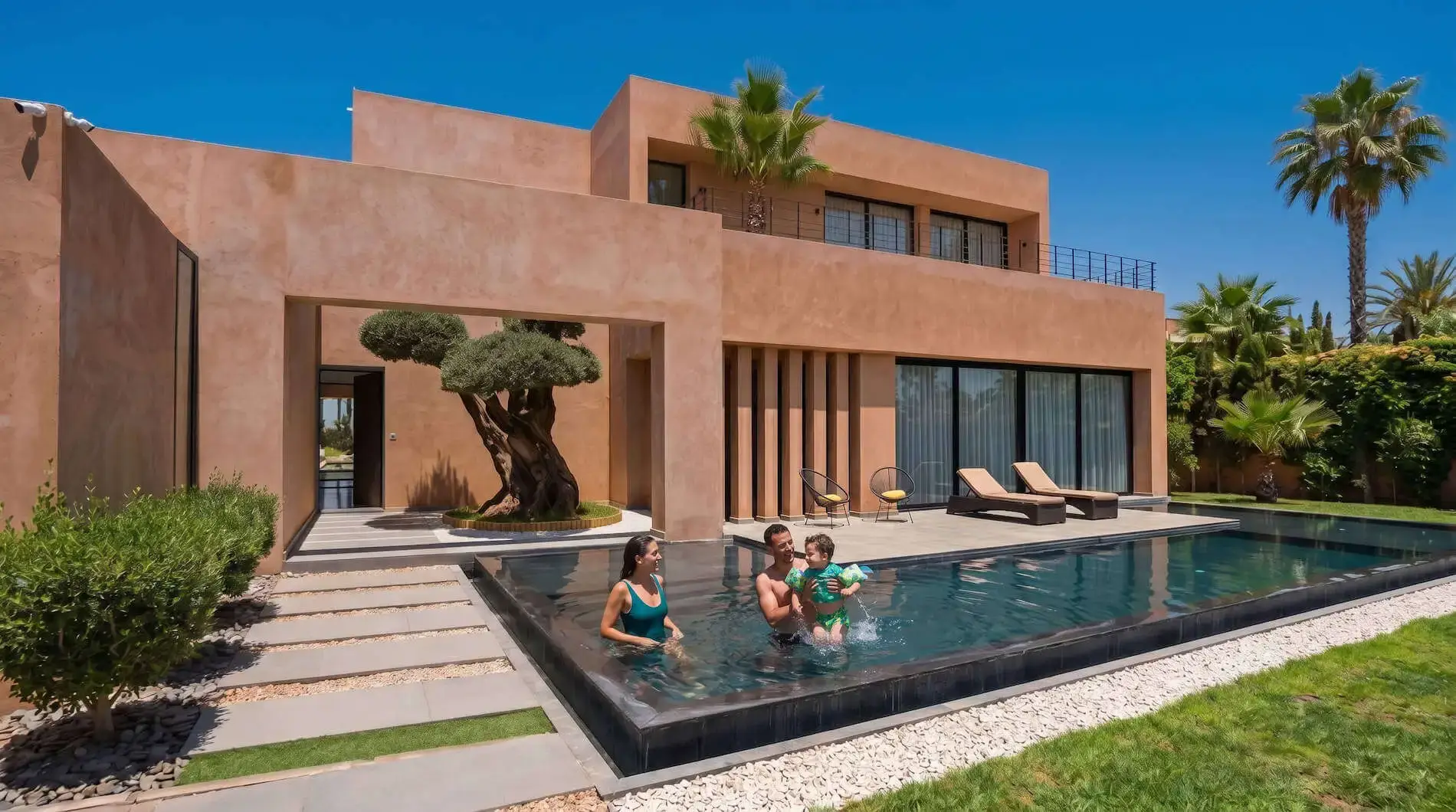
- A house in Morocco or a villa in Palmeraie : high standard, swimming pool, natural setting
- New-build off-plan development : payment in instalments, affordable entry-level prices, ideal for a rental investment
Whatever the type of project, only consider properties with a title deed. The title deed issued by the Land Registry is your best protection. A property without a title deed poses a real legal risk. To compare prices by neighbourhood, see our article on the price per square metre in Marrakech.
Good to know : The title deed is issued by the ANCFCC (National Land Registry Agency). It lists the successive owners, any charges and any mortgages. Always insist on seeing it before signing anything.
The role of the notary and the legal certainty of your purchase
The notary plays a central role in any property purchase in Morocco. It is the notary who verifies the title deed, draws up the authentic deed and places the funds on hold in a secure account. No payments should be made outside the notarial process. This is an absolute rule. A local legal expert or solicitor may also be called upon to assist foreign investors with complex projects.
The steps and procedures for buying a property in Morocco from France
Here are the key steps in the purchase process from France. Every step is important. None of them can be improvised.
Step 1: Find the property, assess the prices and consult the right experts
Research is key. In Marrakech, prices vary considerably depending on the neighbourhood and the type of property. An apartment in Guéliz costs between 12,000 and 20,000 MAD per square metre. A riad in the Medina can cost up to 50,000 MAD per square metre. For a concrete example of how prices compare by neighbourhood, see our guide to the neighbourhoods of Marrakesh is a good place to start. Calling on a local expert helps you avoid pitfalls and negotiate a fair price. The difference between the advertised price and the actual price of a transaction is often between 10 and 20 %.
Step 2: the preliminary sale agreement, payment of the deposit and the title deed
Signing the preliminary sale agreement sets out the price, the terms and the timeframe. A deposit of 10 % is paid to the notary into an escrow account. This initial payment guarantees the seriousness of your offer. At the same time, the solicitor checks the title deed with the Land Registry. This check ensures there are no encumbrances and that the plans are in order. It usually takes 4 to 8 weeks.
Step 3: the deed of sale, the final formalities and the transfer of ownership
The deed is signed at the notary’s office. The balance of the purchase price is paid to the seller. The title is registered in your name. The notary also handles the declaration to the Foreign Exchange Office, a key formality to ensure the future repatriation of your funds. You are now officially the owner. The formalities are complete.
Good to know : The notary fees and registration charges account for between 6 % and 7 % of the sale price. You must factor this into your budget from the outset, without exception.
Mortgages in Morocco: financing and conditions for non-resident French nationals
It is possible for a non-resident French national to secure a mortgage in Morocco. Moroccan banks regularly assist foreign investors. However, the conditions are specific. Here is what you need to know before approaching a local bank.
Interest rates, deposit and charges: the terms and conditions of a mortgage in Morocco
Moroccan banks finance up to 70 % of the property’s price. The minimum deposit is 30 %. The costs associated with the loan include an interest rate of between 4.5 % and 6 %, life insurance and a mortgage on the property. These are fixed costs that must be factored into your profitability calculations. For your application, please have your passport, your last three payslips, your tax assessment notices and your statement of assets to hand.
An interesting option for French investors: financing the project via a loan taken out in France, secured against an existing property. The rates are often more favourable. Use our mortgage simulator in Morocco to compare the two options and estimate your borrowing capacity.
Advice : Investors are always advised to compare the two financing options. A loan in France secured against an existing property can offer far more favourable terms than a local loan. This approach yields a higher return over the long term.
Buying a riad in Marrakech in 2026: advantages, purchase and seasonal rental investment
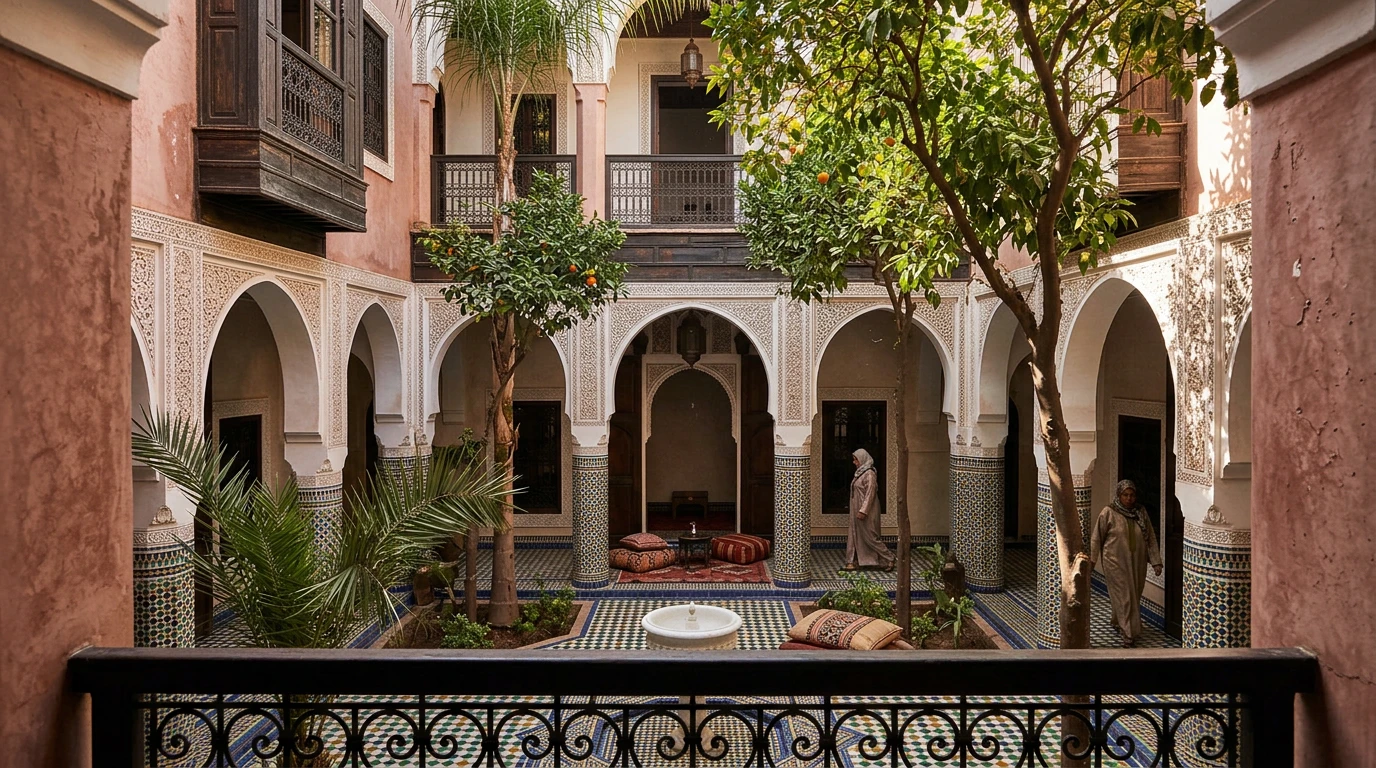
Buying a riad in the Medina of Marrakech is proving very popular with French investors. The charm of Andalusian architecture, the shaded courtyards, the tadelakt and the zellige tiles. It’s often love at first sight. But this type of purchase has its own rules. Here are the essentials.
Acquisition procedures and architectural regulations in the Medina
The Medina of Marrakesh has been a UNESCO World Heritage Site since 1985. Any renovation must comply with strict architectural guidelines. A qualified architect is required, as is a planning permission issued by the local council and, for listed properties, the approval of the Historic Monuments Inspectorate. Traditional materials must be used for visible elements. Our comprehensive guide to renovating a riad in Marrakech explains each step in detail. To choose the right location, see our article on the best neighbourhoods in which to buy a riad.
Before buying, have a structural survey carried out by a local expert. Older properties are often terraced and may harbour hidden structural weaknesses. This is the very least you should do. We have seen far too many investors discover these problems after the purchase.
Seasonal rental potential and remote investment management
A well-renovated riad can generate a gross return of between 6 % and 10 % per year. Its proximity to the souks and tourist attractions is a key asset for holiday lettings. The high demand from tourists in Marrakech in 2026 makes this type of investment a very sound choice. Thanks to our riad profitability calculator, you can estimate your actual return. If you wish to outsource property management, our property management service supports non-resident owners every step of the way.
“The best-performing riads aren’t necessarily the largest. It’s the quality of service and customer reviews that drive occupancy rates. The figures don’t lie.”
— Arnaud Duysens, co-founder of Klair & Arno
Taxation on property purchases in Morocco: charges, exemptions and repatriation
Taxation is often overlooked. Yet it is this factor that determines the true profitability of a property investment in Morocco. Here are the key points.
Costs at the time of purchase: detailed charges and fees
When buying a property in Morocco, you should allow for additional costs amounting to between 6 % and 7 % of the sale price. Here is a breakdown of the costs:
| Tax / Fees | Rate | Frequency | Beneficiary |
| Registration fees | 4 % | Upon purchase | Tax authorities |
| Land conservation | 1,5 % | Upon purchase | ANCFCC |
| Notary fees | ~1 % | Upon purchase | Notary |
| Local services charge | Rental value | Annual | Municipality |
| Council tax | According to the scale | Annual | General Treasury |
| TPI (capital gain) | 20 % min. | For resale | Directorate-General for Taxation |
Some new-build developments are eligible for temporary exemptions from council tax. For other types of property, there is no general exemption. A solicitor or specialist accountant can advise you based on your circumstances.
Rental income, TPI and guarantee of the retransfer of funds
Once you become a homeowner, you pay council tax and municipal services tax. If you let out your property, the rental income is taxable in Morocco, subject to a 40 % allowance for expenses. The Franco-Moroccan tax treaty prevents double taxation. Consult a chartered accountant regarding your personal circumstances.
On resale, the property gains tax (TPI) is a minimum of 20 % of the capital gain. This rate decreases depending on the length of ownership. To repatriate your funds to France under the retransfer guarantee, your purchase must have been made via a convertible dirham account. Without this declaration, repatriation is spread over 4 years at 25 % per year.
Good to know : The declaration to the Foreign Exchange Office is handled by the notary when the deed is signed. Keep the certificate in a safe place. It is this certificate that guarantees your right to repatriate funds when you sell the property.
Marrakech in 2026, Casablanca, Rabat: which property market should you choose in this country?
The Moroccan property market offers some excellent opportunities, depending on the city. Here is an overview for French investors.
Casablanca and Rabat: the property market in the country’s major cities
Casablanca is the country’s economic capital. The property market there is mature, with strong demand for commercial lettings and a well-established expat community. Investors targeting Casablanca are generally looking for a stable, long-term rental yield. Rents in premium neighbourhoods are high. The distance between Casablanca and Marrakesh is 240 km, which is less than 3 hours by train. Casablanca is more business-oriented than tourist-oriented.
Rabat, the administrative capital, attracts diplomats and international civil servants. The property market there is quieter, with prices lower than in Casablanca. The distance between Rabat and Marrakesh is 330 km. Ouarzazate, further south, appeals to investors looking for affordable land and a complete change of scenery.
Marrakech in 2026: strong demand and opportunities for French investors
For a French investor seeking a return on tourist rentals, Marrakech remains the number one choice. In 2026, Marrakech is seeing strong tourist demand, with over 4 million visitors a year. Menara Airport welcomes over 6 million passengers. The climate enjoys over 300 days of sunshine a year. The advantages are real and the property market continues to grow. Morocco can also appeal to a wide range of investors, depending on the region targeted. Take a look at our guide to the’shopping in the Medina of Marrakesh To find out more.
Conclusion: key points for a successful property purchase in Morocco
Buying property in Morocco as a French national is straightforward. You just need to follow the right steps. Here are the key points:
- Secured assets only : The certificate of ownership is your protection, without exception
- A notary is required : legal certainty, funds frozen, no payments made externally
- Convertible dirham account from the outset: a condition of the guarantee of re-transfer to France
- Notary fees: 6 % to 7 % : to be included in the budget from the very first simulation
- Compare financing options : a Moroccan loan or a French loan, depending on your plans and your financial circumstances
Are you ready to take the plunge? Take a look at our properties available for purchase.
FAQ: your questions about buying property in Morocco as a French national
Can a French national buy a property in Morocco?
Yes, without restriction. A French national can buy a flat, a house or a riad in an urban area in Morocco. The regulations do not distinguish between nationalities in urban areas. The only restriction applies to agricultural land. For any other type of property, you have the same rights as a local buyer, provided you are looking to purchase a property with a title deed.
Is it worth shopping in Morocco?
Yes. There are numerous advantages: competitive prices, an attractive quality of life, and strong rental demand in Marrakech. A well-managed riad can yield a gross return of 8 % to 10 %. Casablanca and Rabat offer opportunities for long-term rental investment. The key is to factor in service charges, purchase costs and taxes into your calculations.
What pitfalls should you avoid when buying property in Morocco?
The most common pitfalls identified by experts: buying without a title deed, paying outside the notarial system, failing to open a bank account in convertible dirhams, and underestimating the cost of renovation in the Medina.
How can I get a mortgage in Morocco whilst living in France?
Moroccan banks finance up to 70 % of the property’s value for non-residents. The interest rate ranges from 4.5 % to 6 %, with costs including life insurance and mortgage fees. You will need a passport, proof of income and a minimum deposit of 30 %. Use our mortgage calculator to estimate your borrowing capacity and compare it with financing options in France. This is the best way to optimise your investment project.