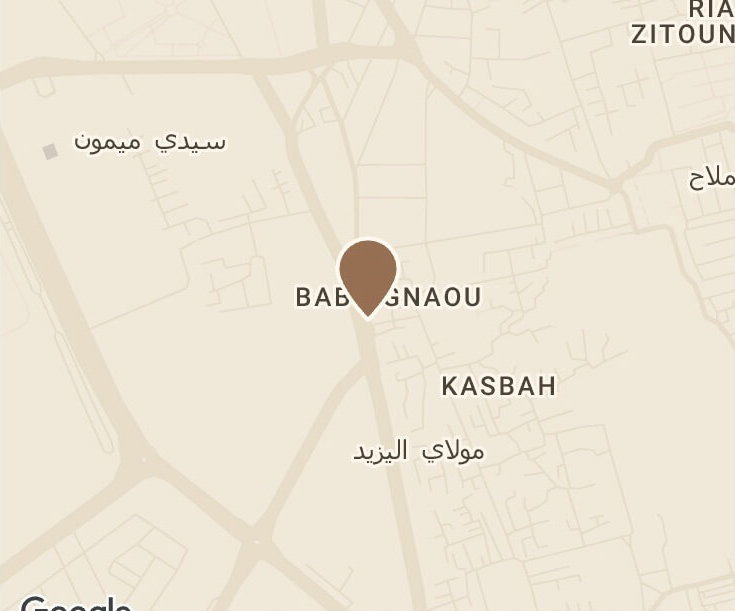
The the tanners’ quarter in Marrakech is situated in Bab Debbagh, at the north-eastern end of The medina. Around fifteen tanneries still operate there, using a traditional method dating back several centuries. The best time to visit is in the morning; there is no compulsory paid guide, and you can buy leather at the Tanners’ Gallery Prices are always negotiable, with price differences of up to 40 % between the initial asking price and the final price.
Contents :
The Tanners’ Quarter in Marrakech: an introduction and its location
The the tanners’ quarter in Marrakesh occupies the north-eastern corner of the medina, around the Bab Debbagh gate. This location is by no means insignificant: historically, it marked the city’s boundary, where the foul odours and wastewater from tanning could be discharged without disturbing the residential centre. It is usually visited as the final stop on a stroll through the souks, after passing through several shopping streets less frequented by organised tour groups.
Tanning in Marrakech dates back several centuries, with some historians suggesting that the craft has been practised continuously since the Almoravid period. The craft has been passed down from family to family, with the tanning pits often belonging to the same families for generations. It is this continuity – rare for such a physically demanding craft that explains why the tanneries in Marrakech are among the best-documented sites in the medina, on a par with Jemaa el-Fna Square or the Majorelle Gardens.
On the ground, there are now around fifteen tanneries still in operation in Bab Debbagh, compared with several dozen at the start of the 20th century. This decline can be attributed to competition from industrially produced leather, the arduous nature of the trade and the ageing of the artisans, many of whom are struggling to find successors.
How to get there from Jemaa el-Fna
It’s about a 20- to 25-minute walk from Jemaa el-Fna Square, taking you through the dyers’ souk and then the potters’ quarter. A small taxi will take you there in 8 to 10 minutes, depending on traffic, for a fare usually between 15 and 25 dirhams if the meter is used, or after negotiating directly with the driver.
How traditional tanning works in Marrakech
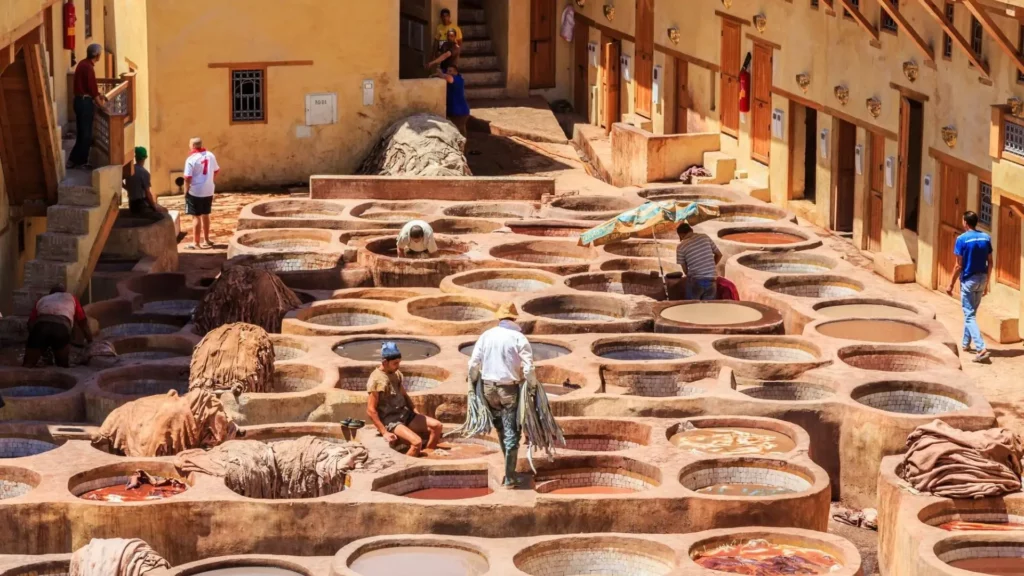
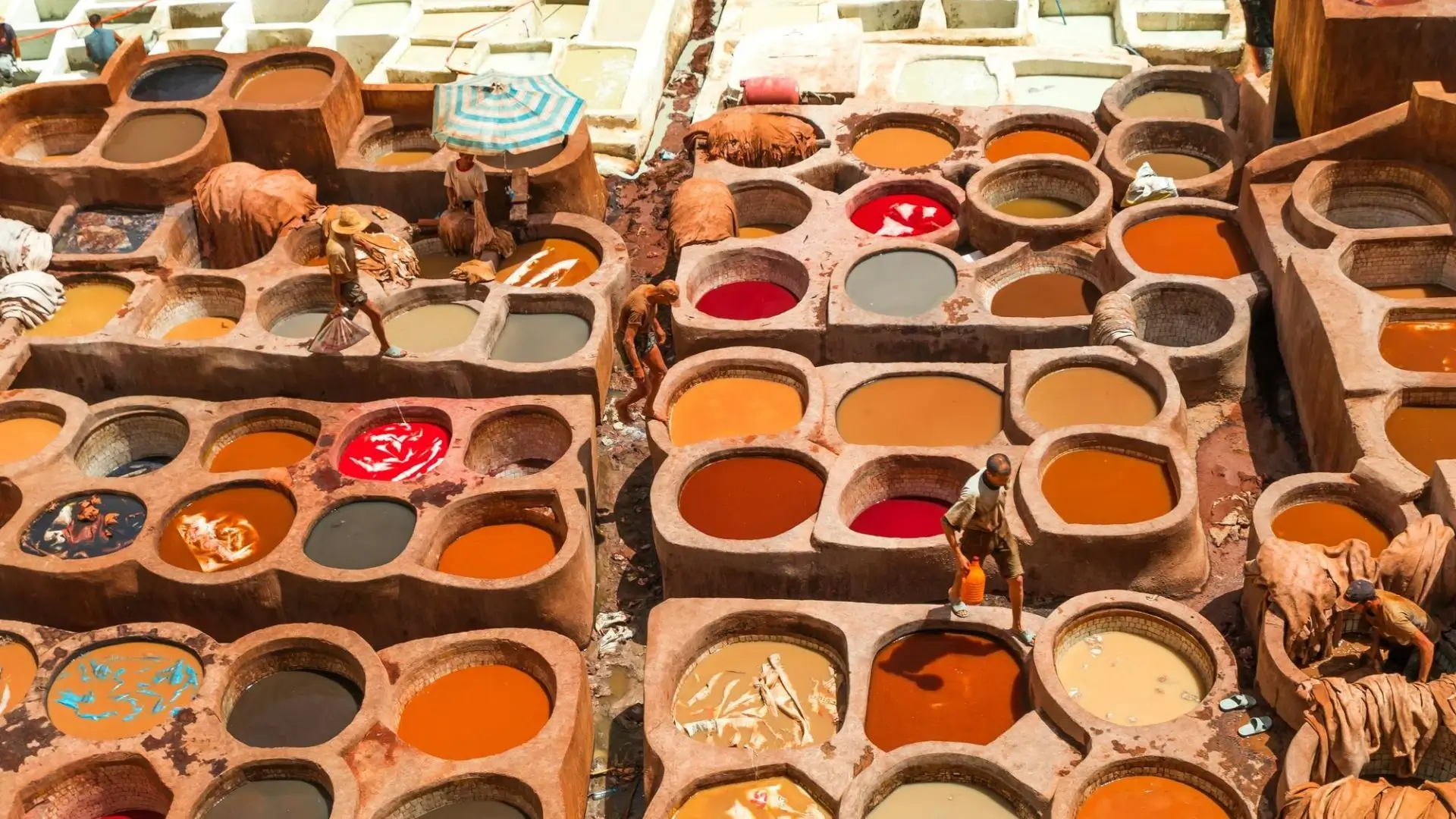
The process observed in a Marrakech tannery The traditional process follows a precise sequence. The hides – mainly from cows, goats and camels – are first soaked in basins of water and salt to soften them and remove any residue. They are then placed in lime vats to remove the hair and soften the fibres, a process that usually takes several days.
Next comes the tanning process itself, carried out using tree bark, sumac or plant extracts, prior to dyeing. Traditional pigments are still used in some workshops: saffron for yellows, indigo for blues, and sometimes even pigeon droppings in the liming mixture – an ancient practice which helps to soften the leather thanks to its natural enzymes.
- Soaking and desalting of raw hides
- Liming and hair removal in alkaline vats
- Vegetable or mineral tanning, depending on the workshop
- Dyeing by successive pigment baths
- Air-drying on the neighbouring terraces
The famous open-air vats, arranged in a honeycomb pattern, are not simply an aesthetic choice: this circular layout optimises floor space whilst making it easier for the craftsmen to move between the vats. The trade secrets are still passed down orally, from father to son in most cases, although some cooperatives are now attempting to formalise training to ensure the craft is passed on.
Where does the characteristic smell come from, and how can you anticipate it?
The smell, which is often mentioned even before the visit, comes mainly from the liming and the organic residues used in certain tanks. It is strongest in the morning, when the tanks are being refilled, and fades towards the end of the day. Most visitors are given a fresh mint leaf at the entrance: this isn’t just a gimmick; it actually helps to mask the strongest odours.
Good to know : Bring your own handkerchief or a little peppermint essential oil. The leaflet handed out on the spot is rarely given out purely out of goodwill; it often serves as a prelude to an unsolicited guided tour.
Visiting the Tanners’ Quarter: opening times, route and best time to visit
The best time to observe the tanners in Marrakech The busiest time is between 8 am and 11 am, when the vats are full and the artisans are at work. After midday, activity slows down considerably, especially in summer when the heat limits outdoor work. The autumn and spring months offer more comfortable conditions for a visit, with ideal light for observing the colours of the dye vats.
During the peak tourist season, the area remains busy but is never as crowded as Jemaa el-Fna can be. A full tour, including a look at the tanning vats and a visit to a leather shop, takes on average between 45 minutes and 1 hour 15 minutes.
The view from the terraces: a hidden gem or a tourist trap?
Many shops offer «free» access to their terraces so that visitors can take photos of the vats from above. The view is genuine and often spectacular, but this ‘free’ access almost always comes with a guided tour of the shop afterwards, accompanied by sales pressure that varies in intensity depending on the establishment. It isn’t a scam as such, but rather an implicit quid pro quo that you should be prepared for.
Buying leather at the Tanners’ Gallery: price and quality
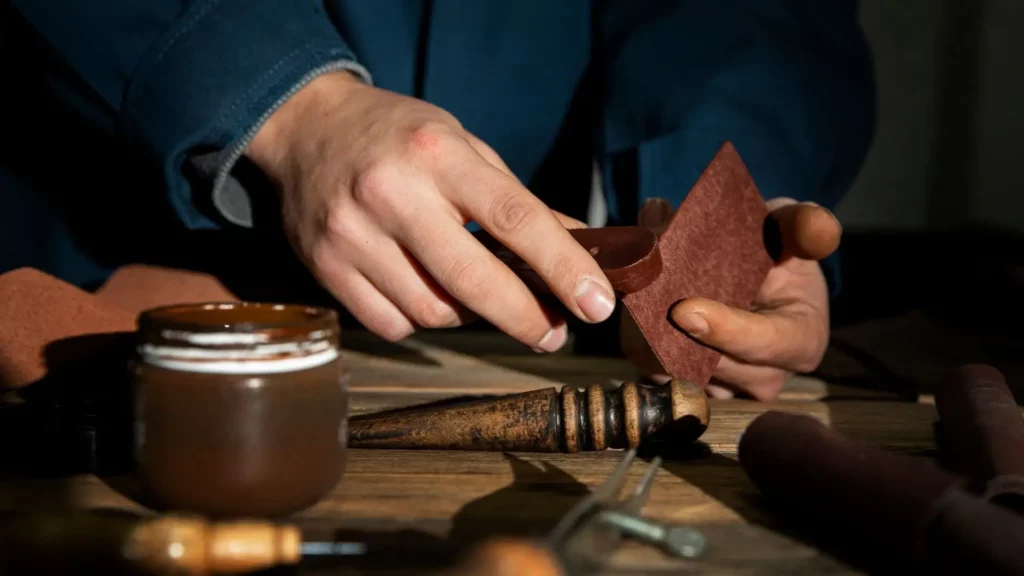
La Galerie des Tanneurs in Marrakech refers to the shops attached to the tanneries, which sell finished products directly: bags, belts, slippers, jackets and pouffes. The shops are still run on a traditional, artisanal basis, with few fixed prices displayed, leaving plenty of scope for haggling.
| Product | Initial price shown | A realistic negotiated price |
|---|---|---|
| Leather slippers | 250 to 400 MAD | 120 to 200 MAD |
| Leather handbag | 600 to 1,200 MAD | 350 to 700 MAD |
| Leather belt | 200 to 350 MAD | 100 to 180 MAD |
| Leather jacket | 1,500 to 3,000 MAD | 900 to 1,800 MAD |
High-quality leather can be recognised by several simple criteria: a plant-based, rather than chemical, smell; natural suppleness without being excessively stiff; even stitching; and a uniform colour that does not run when in contact with damp fabric. Shoddy finishes, uneven stitching or visible glue generally indicate that the product is intended exclusively for the tourist market.
When it comes to negotiations, the rule of thumb in the sector is to offer around 40 to 50 % of the initially quoted price, and then gradually move towards an agreement of between 55 and 70 % of that starting price.
Whilst I was there, I saw visitors paying three times the price of an identical item bought a few minutes later by another customer, simply because they hadn’t haggled. The leather market in Marrakech is by no means a mystery once you know the actual price ranges; you simply need to approach the haggling with some figures in mind.
Claire Emeriau
Vegetable-tanned leather vs. chemically-tanned leather: what are the differences for the buyer?
Vegetable-tanned leather, produced using the traditional process described above, develops a patina as it ages and retains a natural smell that fades over time. Chemically tanned leather, often chrome-tanned, is cheaper to produce and more visually uniform, but can sometimes have a more pungent odour and is more prone to cracking if exposed to the sun for prolonged periods. For a buyer, price remains the most reliable indicator: an item authentically tanned using traditional methods rarely sells for less than a certain price, given the time required for production.
Practical tips for avoiding tourist traps
Solicitors are the main cause for concern at the entrance to the neighbourhood. They often introduce themselves as employees of a tannery or as students wishing to practise their French, before offering a tour that invariably leads to a partner shop. Their presence does not mean the tour will be unpleasant, but it does mean that a commission is included in the final price of the items sold.
An official guide, recognisable by their badge issued by the tourist authorities, usually charges between 150 and 300 MAD for a tour of the medina, including the tanners’ quarter. This price is a guide only and should be negotiated in advance, never after the tour has taken place.
- Polite but firmly decline any unsolicited offers to act as a guide
- Agree on the price of a taxi fare or a guide’s fee before setting off
- Keep your camera to hand, but avoid displaying it conspicuously in narrow alleyways
Watch out : A tip of 10 to 20 MAD is still common following an unscheduled visit to a tannery, but no amount is legally required. Be wary of insistent requests accompanied by a specific figure; this is not standard practice.
The dyers’ souk and the neighbouring artisan districts
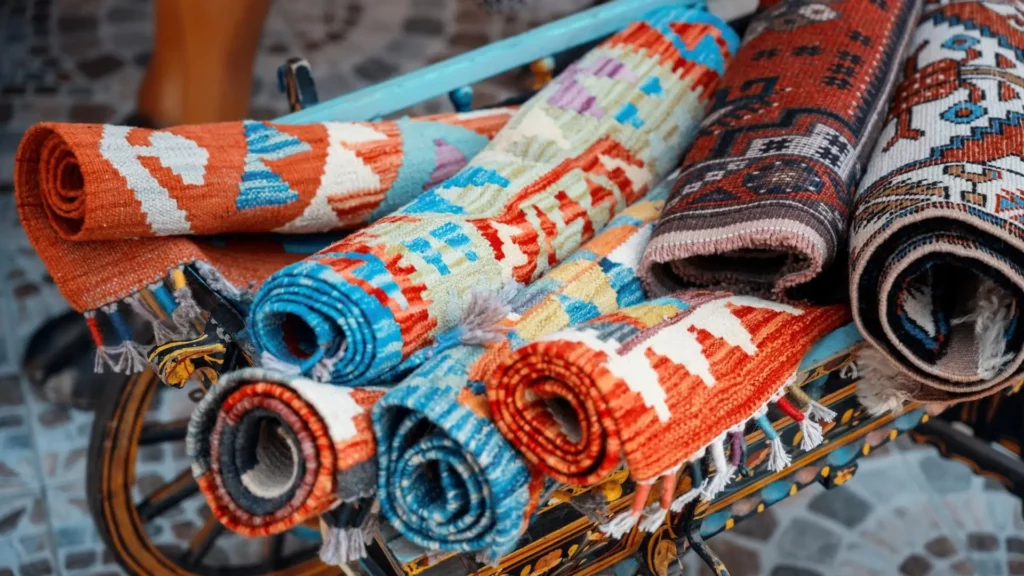
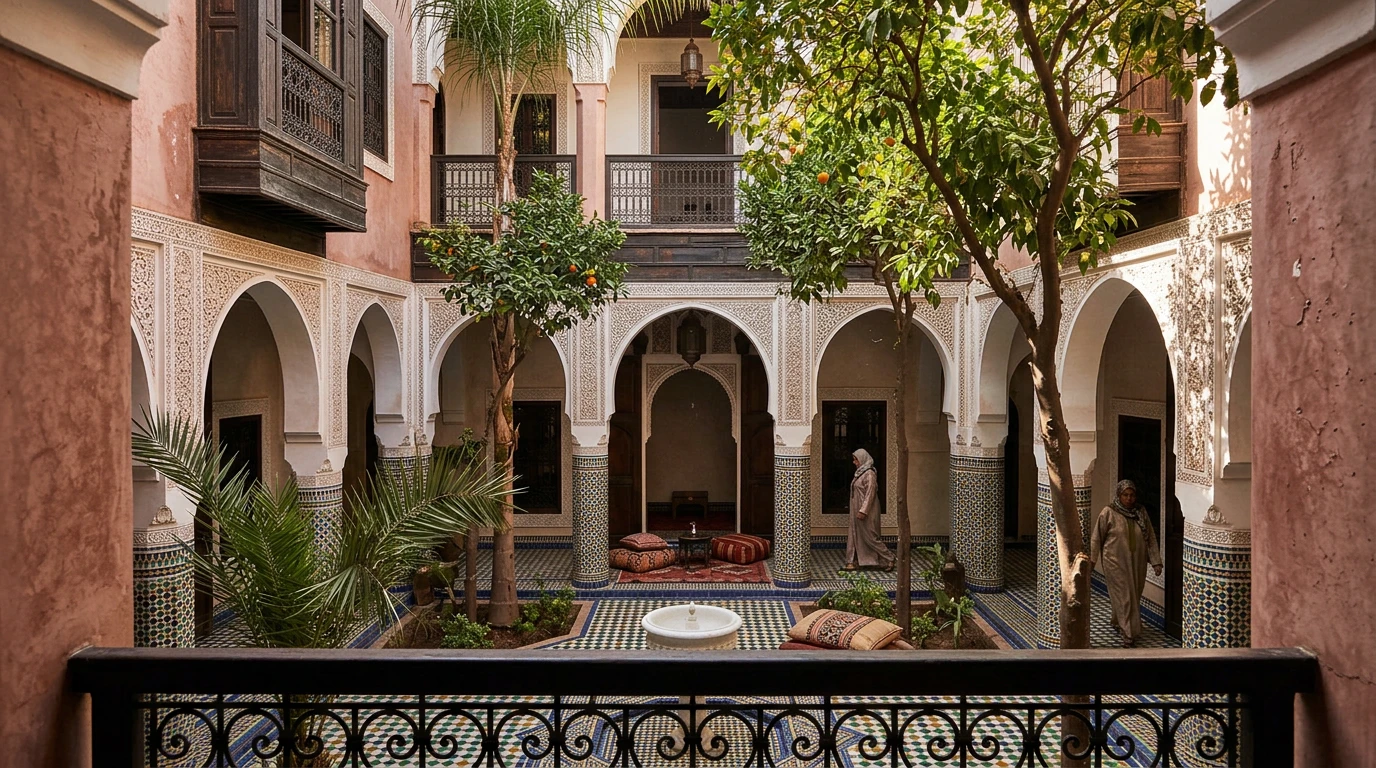
The the dyers’ souk in Marrakech Geographically, it lies before the tanners’ quarter on the classic route from Jemaa el-Fna. It differs markedly from it: here, wool and cotton yarns are dyed whilst suspended in colourful skeins, whereas Bab Debbagh is devoted exclusively to the working of animal hides. Both quarters, however, share a common structure, consisting of open-air workshops grouped by guild, a direct legacy of the medieval organisation of the medina.
In the immediate vicinity, there are also pottery and metalwork workshops, which are less well-known but just as authentic. A logical itinerary involves visiting the dyers’ souk, the pottery district and then the tanneries, on a tour lasting around two hours, including time for looking around and any shopping.
Key points to remember : Visit early in the morning, turn down unsolicited guides, always haggle for around 50 % off the displayed price, and combine your visit with the dyers’ souk for a comprehensive half-day tour of the local crafts.
FAQ
Where exactly is the tanners’ quarter in Marrakech?
It is situated in Bab Debbagh, at the north-eastern end of the medina, about a 20- to 25-minute walk from Jemaa el-Fna Square.
What is the best time of day to visit the tanneries?
The morning between 8 am and 11 am is still the best time, as the vats are full and the craftsmen are hard at work, before the heat slows things down later in the day.
How can you avoid scams and fake guides in the Tanners’ Quarter?
Politey decline any unsolicited offers of a guided tour at the entrance to the neighbourhood and always agree on a price before any service is provided, whether it’s a tour or access to a terrace.
Do you have to pay for a guide to visit the Tanners’ Quarter?
It is not compulsory; you are free to explore at your own pace, but an official guide wearing a badge can provide further insight into the tanning process for a fee of between 150 and 300 MAD.
What are the average prices of leather goods at the Tanners’ Gallery?
After haggling, expect to pay between 120 and 200 MAD for a pair of slippers, between 350 and 700 MAD for a bag, and between 900 and 1,800 MAD for a leather jacket of decent quality.
Is leather tanning in Marrakech still carried out using traditional methods today?
Yes, around fifteen tanneries still operate using the traditional method based on lime, salt and natural pigments, a technique passed down from generation to generation despite the decline in the number of artisans.