In brief: Hire a short-stay riad at Marrakech This involves declaring a tax status, bringing the property up to the standards expected by international travellers, and choosing a suitable marketing channel. There are five stages to this process, from establishing a legal status to the secure collection of payments.
One figure is enough to gauge the density of the market: the comparison platform Cozycozy lists more than 23,000 short-term rental listings at Marrakech in 2026, across all property types. How can you stand out from this sea of listings? The landlord who improvises their listing short-term let quickly loses visibility – and often profitability. This guide sets out, step by step, what short-term letting of a riad with 1 bedroom and 1 bathroom, from administrative requirements to the day-to-day management of passengers.
Short-term letting refers to a furnished stay lasting from a few nights to a few weeks, booked via a platform such as Airbnb or Booking, or directly with the owner. It is distinct from long-term letting, which is governed by a standard residential tenancy agreement binding both parties for several months or even several years. This distinction determines the tax status to be adopted, as we shall see later.
Before you begin: the requirements for renting a riad on a short-term basis at Marrakech
Before even considering a rental riad marrakech private individual, three points need to be clarified: the documents you have available, the budget you can commit to, and the actual condition of the property. In the cases we handle, neglecting this preparatory phase is the main cause of delays. It explains the frequent gap between the intention to let and the first booking payment received.
Administrative documents
The title deed (or commercial lease, if you are operating the business without owning the premises) is the key document. You will also need a valid form of identification. Depending on the scale of the business you are planning, you may also need to register as a sole trader or set up a limited liability company (SARL) with the Moroccan authorities. Without these documents, no reputable platform or professional concierge service will agree to work with you on a long-term basis.
Initial budget
The cost of bringing the property up to standard varies considerably depending on the condition of the riad. For a property that is already in good condition, expect to pay between 8,000 and 15,000 euros. This sum covers upgrading the bathrooms, installing air conditioning in the bedrooms and replacing the bedding with hotel-standard items. For a riad requiring structural renovation of the patio or roof, the cost often rises to between 30,000 and 80,000 euros, depending on the surface area and the quality of the materials chosen.
Property condition
The location of the riad – whether within or outside the medina – is one of the key criteria. Accessibility via narrow streets that are sometimes too narrow for a vehicle, the availability or otherwise of nearby parking, and the property’s actual accommodation capacity are equally important factors. A tourist classification or operating licence may be required from the local authorities. This is often the case when the riad has more than a certain number of rooms or is aimed at a high-end clientele.
The key figure
According to specialist agencies, luxury riads in the medina are generally rented out for between 800 and 2,200 euros per night in 2026, a range that primarily reflects the property’s size, the standard of its facilities and its proximity to iconic squares such as Jemaa el Fna.
Step 1: Determine your legal and tax status before letting out your property
Occasional letting, for a few weeks a year, does not require the same regulatory framework as a regular commercial activity. As soon as the letting becomes a recurring activity and generates a regular income, the Moroccan tax authorities regard it as a professional activity, which must be declared.
There are three options available, depending on the expected volume of business. The ‘auto-entrepreneur’ status is suitable for a small sole trader business; a civil-law property company (SCI) allows for the organisation of family property ownership; and a limited liability company (SARL) is often the best option as soon as several properties are being managed or a foreign investor sets up their business locally. Rental income must be declared. It may also be subject to local business tax, the rate of which varies depending on the local authority and the nature of the declared business activity.
I have seen several property owners discover, two or three years after their first booking, that they needed to regularise an activity they had thought was only occasional. You must choose your status before you receive payment for your first overnight stay, not after an inspection.
Arnaud Duysens
Step 2: Prepare the riad to welcome guests (estimated timeframe: 1 to 3 months)
Once the status has been determined, work begins on bringing the property into compliance. You should generally allow for a period of 1 to 3 months between the start of the work and the publication of the first advert, depending on the scale of the work required.
Building works and renovation
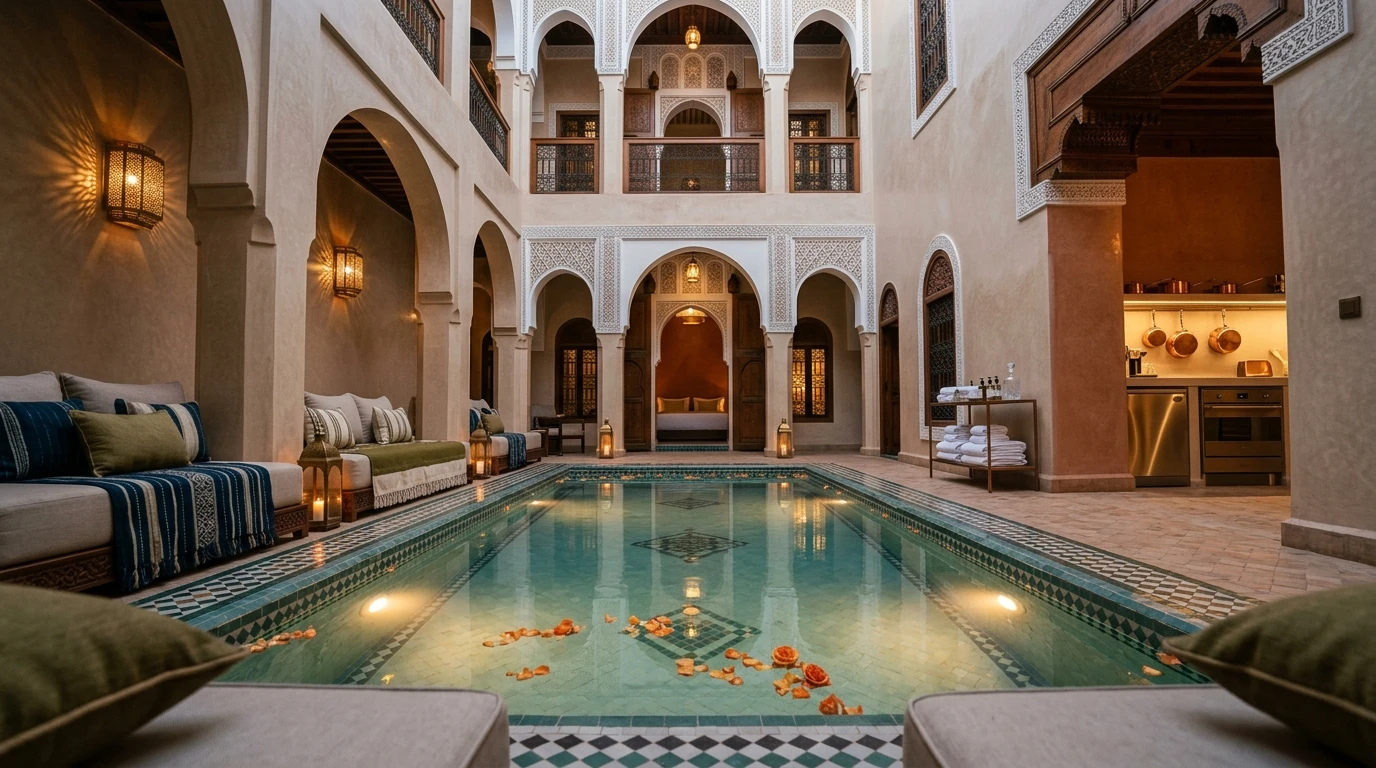
The most common works involve renovating the traditional patio (zellige tiles, fountain, planting) and upgrading the electrical system to meet current standards. This is usually supplemented by the refurbishment of the bathrooms and the installation of reversible air-conditioning in each bedroom. These items often account for the bulk of the budget, particularly in the older riads of the medina.
Essential equipment
International travellers expect a specific standard of facilities: a reliable Wi-Fi connection, a fully equipped kitchen if the riad offers self-catering accommodation, hotel-standard bedding, and nearby parking where access by car is possible. For a flat to let (1 bedroom, 2 bathrooms) for a short-term let or a short-term studio flat (marrakech) to let, the main focus is on cleanliness and functionality. For a family-run or luxury riad, however, the emphasis shifts to service and aesthetics.
- Studio or small flat: estimated fitting-out budget of between 5,000 and 10,000 euros
- Family-run riad (4 to 6 bedrooms): estimated budget of 20,000 to 40,000 euros
- Luxury riad with a swimming pool and dedicated staff: indicative budget of 50,000 to 100,000 euros and above
Step 3: Set your price and choose your distribution channels
Live streaming, via a dedicated website or social media, avoids platform commissions (often between 15 and 20 % on Airbnb and Booking) but requires you to build your own visibility. In return, platforms offer unrivalled traffic volumes. It’s worth noting that Cozycozy lists over 23,000 short-term rental listings at Marrakech, a competitive environment where multi-channel promotion is almost a natural choice.
Pricing depends on three factors: the season (high season from October to April, low season in summer), the location (the Medina, Gueliz, Hivernage) and accommodation capacity. A short-term tenancy agreement, even in a simplified form, must set out the general terms and conditions for the traveller: length of stay, total cost, cancellation policy and house rules. This document protects both parties in the event of a dispute.
Step 4: Organise day-to-day operations (reception, cleaning, caretaker services)
The owner has three options: managing the property themselves, using a concierge service riad marrakech for one-off tasks, or full delegation to an agency specialising in riad rental management. KNA and CD Immobilier are examples of this latter model. Agencies such as KNA offer a fully managed rental service including daily cleaning, a private chef and a concierge service seven days a week – a level of service aimed primarily at luxury riads.
Property management fees are generally a percentage of rental income, usually between 20 and 35 % depending on the scope of services included. Cleaning between stays, and managing check-ins and check-outs are among the most time-consuming day-to-day tasks. This is often the first task to be outsourced, even by owners who retain control over marketing.
Good to know
A local concierge service can be hired on an ad hoc basis (for one-off reception duties, cleaning, etc.) without a commitment to full management – an intermediate option that is often well-suited to riads run on a part-time basis by their owners.
Step 5: Secure the relationship with the traveller and collect payments
The standard practice at Marrakech in 2026 is to request a deposit of 25 to 30 % at the time of booking. The balance is paid on arrival or a few days before the stay, depending on the agreed terms. A security deposit, which is usually refunded within 48 to 72 hours after departure, covers any damage.
Cancellation terms must be specified at the time of booking: a full refund up to a certain deadline, followed by a sliding scale of refunds as the date of the stay approaches. As for payment, methods accepted locally include bank transfer and cash payment on arrival. International payment platforms and credit/debit cards, meanwhile, facilitate transactions with foreign customers, who make up the majority of the clientele in this sector.
| Action | Estimated cost | Deadline |
|---|---|---|
| Choosing your legal and tax status | Registration fees vary depending on status | 2 to 4 weeks |
| Renovating and furnishing the riad | €5,000 to €100,000, depending on the size of the property | 1 to 3 months |
| Set the price and publish the advert | Platform commission: 15 to 20 % | 1 to 2 weeks |
| Organising day-to-day management | 20 to 35 % of revenue in the event of full delegation | Continuous |
| Secure bookings and payments | Bank or platform fees, which are minimal | Continuous |
Common mistakes to avoid when renting a riad on a short-term basis from Marrakech
What are the most common mistakes? Here are four of them, which occur frequently enough to warrant being mentioned specifically.
- Underestimating the budget for the renovation and ongoing maintenance of a traditional riad, whose materials (zellige, tadelakt, wood) require annual maintenance that is often overlooked in initial profitability calculations
- Failing to declare rental income on your tax return, on the assumption that an audit is unlikely, which leaves you vulnerable to costly adjustments and penalties
- Setting a rate that is not tailored to the tourist season – the high season runs from October to April, whilst the low season covers the summer – and applying a single rate throughout the year inevitably erodes the occupancy rate
- Entrusting management without a clear contract with an agency or concierge service, which leaves room for differing interpretations regarding the sharing of revenue or liability in the event of damage
Watch out
Local business rates and the declaration of rental income are not optional once the activity becomes a regular one. Failing to comply with this requirement exposes you to a retroactive tax assessment, which is usually accompanied by late payment penalties.
Practical tips for a successful short-term let at Marrakech
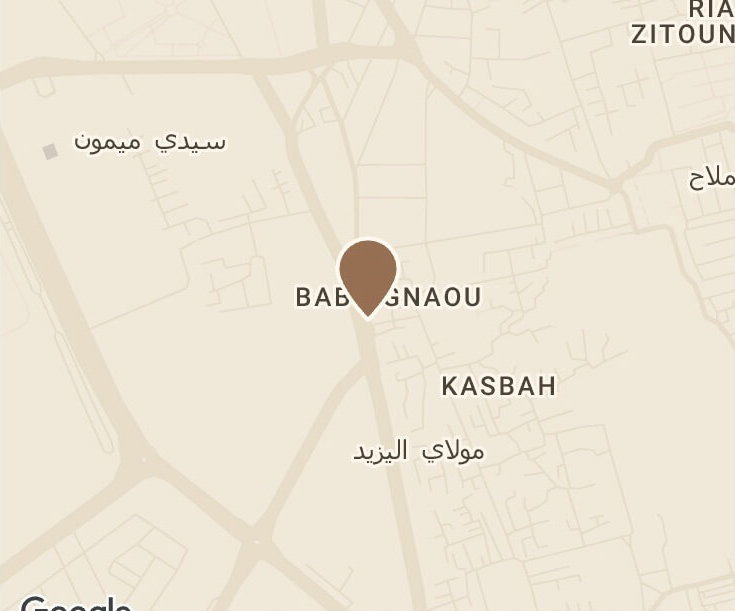
The occupancy rate depends primarily on location. The medina and the Gueliz district account for the vast majority of riads and short-stay apartments on offer. However, the neighbourhoods most sought after by travellers remain the historic medina, Mouassine and Gueliz, due to their proximity to shops, restaurants and the main tourist attractions.
A well-located riad that’s poorly photographed is harder to let than a more modest riad whose listing paints a vivid picture of the experience. On platforms listing tens of thousands of properties, the first visual impression often makes the difference even before the price comes into play.
Arnaud Duysens
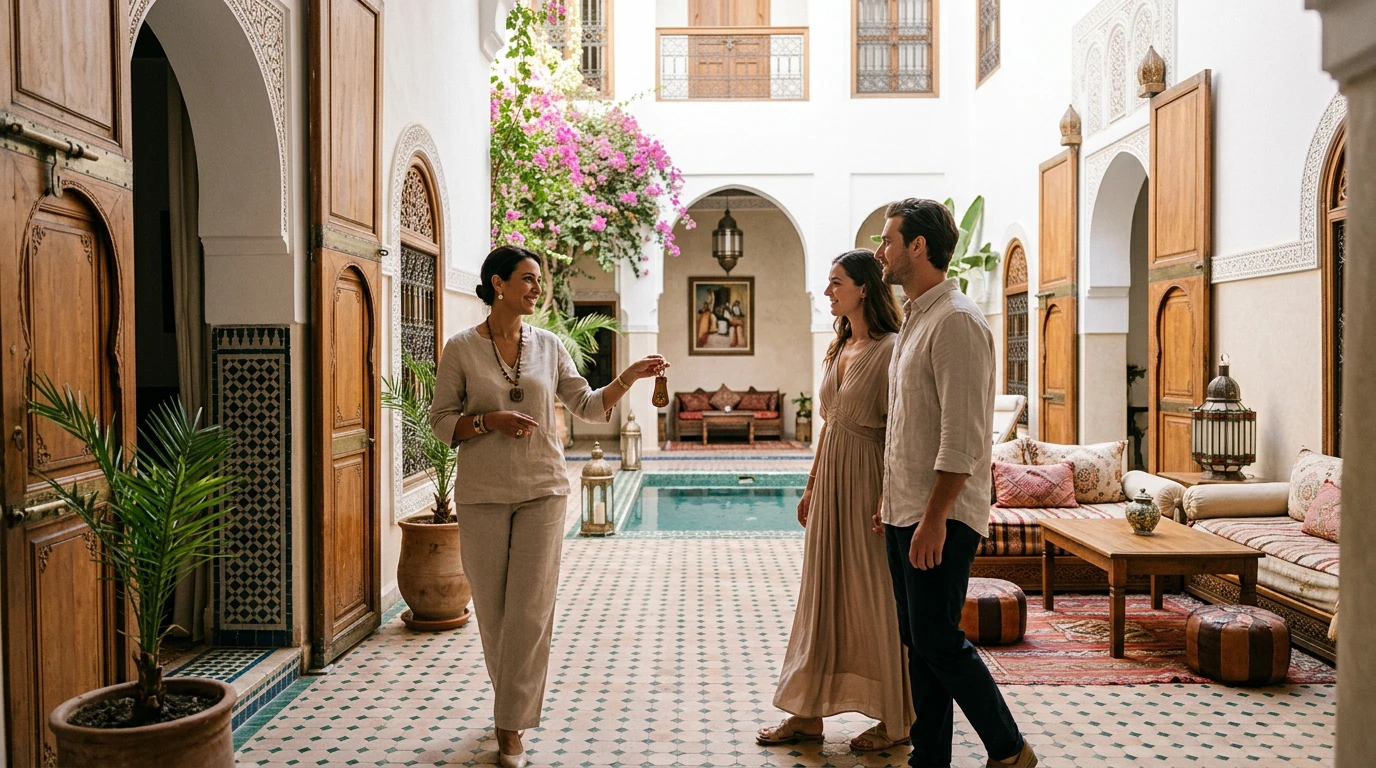
Paying careful attention to photos and descriptions remains an under-utilised strategy: natural light, showcasing the patio, and providing a detailed description of the facilities and the immediate surroundings. Taking Morocco’s seasonal patterns into account when setting your availability calendar also helps avoid unpleasant surprises. Ramadan significantly affects tourist numbers, and the intense summer heat (often exceeding 40 degrees in July and August) naturally reduces demand. This justifies a differentiated pricing policy rather than a fixed price throughout the year.
This set of recommendations, updated in 2026, remains subject to changes in tax legislation and platform practices. It is still advisable to seek periodic advice from a local adviser or a specialist agency before taking any structural decisions.
FAQ
Do you need a special licence to rent out your riad on a short-term basis to Marrakech?
Yes, as soon as the letting becomes a regular arrangement, you will need to register a legal status (self-employed, SCI or SARL, depending on the scale of your business) in order to declare your rental income and avoid having to pay back tax at a later date.
How much should you budget for renovating a riad before putting it up for rent?
The budget ranges from 5,000 to 10,000 euros for a studio, from 20,000 to 40,000 euros for a family riad, and can exceed 50,000 to 100,000 euros for a luxury riad with a swimming pool, depending on the property’s initial condition.
Is it possible to rent a riad on a short-term basis without going through an agency?
Yes, self-management is possible, but it requires you to handle check-in, cleaning between stays and advertising the property yourself; many owners delegate these tasks to a concierge service or a letting agency.
Which platforms should you use to advertise your riad for short-term lets?
Airbnb and Booking remain the most popular channels, with commissions generally ranging from 15 to 20 %; direct marketing via a dedicated website or social media helps to reduce these costs but requires more time spent on sales and marketing.
What is the difference between short-term and long-term rentals for a riad?
Short-term rentals cover stays ranging from a few nights to a few weeks, booked via a platform or directly with the owner, whilst long-term rentals are based on a standard residential tenancy agreement binding the parties for several months or years.
What is the average time it takes to get a riad up and running for rental?
You should generally allow 1 to 3 months between the start of the compliance work and the publication of the first advert, depending on the scale of the renovation required.