Turning a riad into a profitable guesthouse in Marrakech rests on three pillars: a sound legal framework, a realistic budget, and a profitability analysis carried out before the purchase, not after. A riad purchased without a feasibility study can quickly become a financial black hole, even before it welcomes its first guest. In the medina, the charm of a zellige-tiled courtyard or a tadelakt staircase often masks a more prosaic reality: this type of project is managed just like any other hotel investment.
In brief: converting a riad into a guest house with Marrakech This involves securing three distinct areas: legal, technical and financial. The regulatory framework has been thoroughly updated by Law 80-14, its implementing decree of 2023 and the classification order of December 2024. The project’s profitability then depends almost entirely on the actual occupancy rate achieved, rather than on the nightly rate advertised during marketing.
Riad, guesthouse, hotel: what exactly are we talking about?
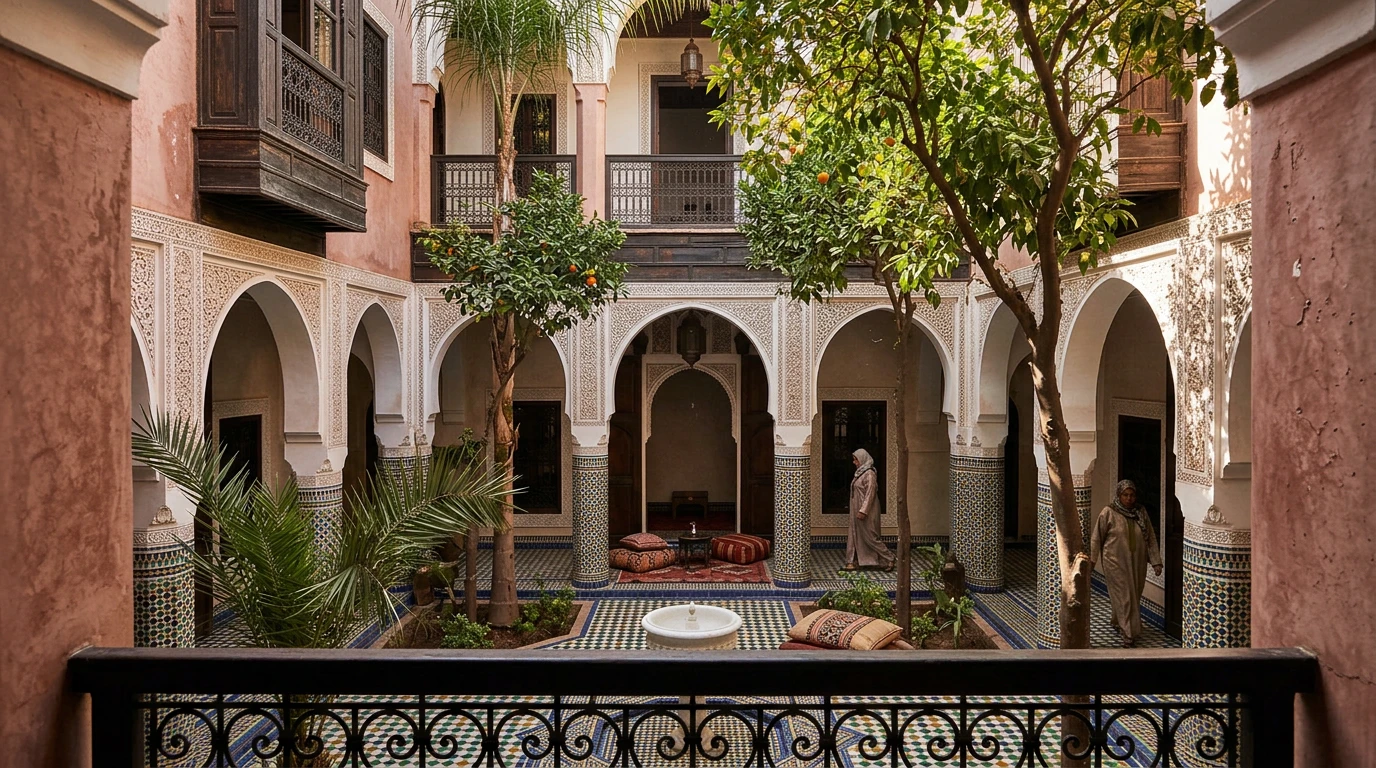
A riad originally refers to a traditional Moroccan residence organised around an inner courtyard, often planted with citrus trees, onto which the living areas open. A guest house is a small-scale tourist accommodation establishment, operated within a residence of distinctive architectural character. It is subject to a regulatory framework distinct from that of classified hotels. This distinction, introduced by Law No. 80-14, directly determines the administrative procedures that must be completed before the establishment can open.
The riad: a traditional courtyard-style building
The buildings in the medina of Marrakech is home to several thousand riads. Some were built between two and four centuries ago, at a time when the layout centred around the courtyard served specific climatic and social purposes: natural ventilation, family privacy, and a hierarchy of spaces between the ground floor and the upper storeys. This age explains both the heritage value of these properties and the structural fragility frequently found in the foundations and load-bearing walls made of rammed earth or unfired brick.
Guesthouse vs hotel: what are the regulatory differences?
A guesthouse differs from a classified hotel in several respects: it has a smaller capacity and is housed in a building of Moroccan architectural character. The presence of the operator or a representative on site is often required, and there is a specific classification procedure. Hotels, on the other hand, are subject to a separate star-rating system, with generally more stringent construction and operational standards. The following table summarises the main differences.
| Criterion | Riad (original building) | Guest house | Listed hotel |
|---|---|---|---|
| Nature | Traditional house with a patio | Small-scale tourist accommodation establishment | Tourist accommodation with a larger capacity |
| Regulatory framework | None, as long as the property remains a residential property | Act 80-14, Decree 2-23-441, Order 985-24 | Law 80-14 and specific hotel classification regulations |
| Typical operator | Owner-occupier | An individual or a company (SARL, SARL AU) | Hotel management company |
This initial clarification determines the course of the entire project: it is the intended status – guesthouse or hotel – that determines the licences required and the applicable classification criteria.
Morocco’s legal framework in 2026: what you need to know before getting started
The regulatory framework governing guesthouses in Morocco is now based on three pieces of legislation: a framework law, an implementing decree and a technical classification order. It is important to familiarise yourself with these before making any financial commitments. These texts have recently been updated, rendering some of the information still circulating regarding the rules in force prior to 2023 obsolete.
Act 80-14 and the 2023 implementing decree
Law No. 80-14, promulgated by Dahir No. 1-15-108 of 4 August 2015, sets out the regulatory framework for tourist establishments and tourist accommodation in Morocco, including guesthouses located in riads. Its implementing decree, Decree No. 2-23-441, came into force on 13 July 2023. It sets out the practical procedures for the authorisation, inspection and closure of such establishments. It is this decree that essentially sets out the procedure for obtaining the ‘riad’ tourism licence under the Marrakech scheme, which is essential for opening an establishment that has been converted into a guesthouse.
Classification Order of December 2024
Joint Decree No. 985-24, dated 24 December 2024, sets out the classification standards applicable specifically to riads and guesthouses. It specifies the accommodation capacity, minimum facilities, safety standards and comfort criteria according to the relevant category. The classification of guesthouses in Morocco is organised into categories, similar to the star-rating system for hotels. An establishment classified as a 5-star riad (Marrakech) must therefore demonstrate that its facilities and services are significantly superior to those required for an entry-level category.
Good to know
The tourism licence and the classification are two separate but complementary processes: the former authorises the operation of the establishment, whilst the latter determines its commercial category. In theory, a riad can obtain its licence without a definitive classification, but it will not be able to claim a specific category to its guests or on booking platforms until the classification has been confirmed.
Which legal structure should you choose: SARL or SARL AU?
To run a riad converted into a guesthouse in Morocco, a limited liability company (SARL) or its single-member variant, the SARL AU, is the recommended legal structure. It offers a balance between management flexibility and administrative credibility with the authorities responsible for issuing licences and classifications. It also limits the operator’s liability to the amount of their capital contribution. A sole project owner will usually opt for the SARL AU in Morocco, even if this means converting the structure into a standard SARL should one or more partners join the project at a later date.
In practical terms, none of these three texts supersedes the other two: Act 80-14 sets out the general framework, Decree 2-23-441 organises the authorisation procedure, and Order 985-24 lays down the classification standards. Failure to comply with any of these three levels exposes the project proponent to a refusal to grant authorisation or to a subsequent challenge to its classification.
How do you choose the right riad to renovate?
The The choice of riad depends on a combination of three criteria: the location within the medina, the available floor space in relation to the target number of rooms, and the actual structural condition of the building. None of these criteria can be assessed in isolation. A well-located riad that is structurally unsound may require renovation work costing the equivalent of several years’ projected rent.
Popular neighbourhoods in the medina
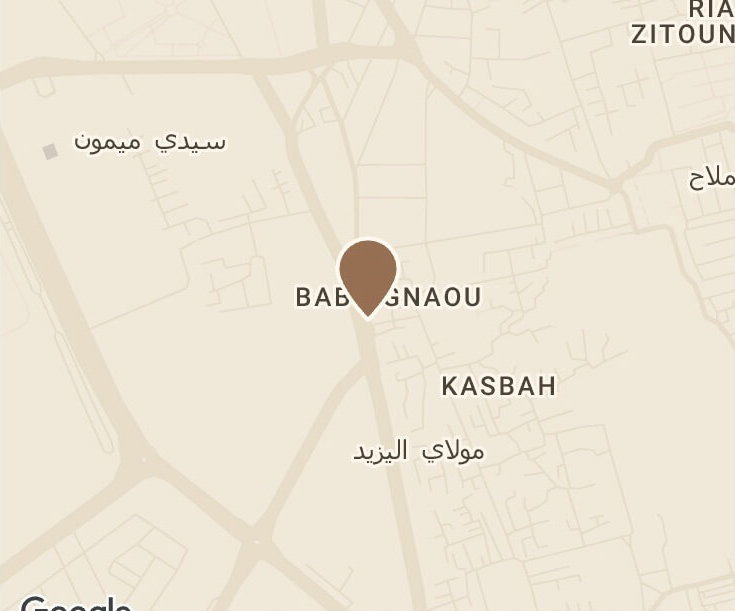
Certain neighbourhoods in the medina of Marrakech are seeing stronger demand from property developers, which has a direct impact on the purchase price per square metre. Dar El Bacha, near the museum of the same name, Mouassine – prized for its renovated alleyways and proximity to tourist hotspots – and Bab Doukkala, which is more out of the way but generally more affordable in terms of purchase price, are among the most sought-after areas. The desired size – a riad for around ten people, or for twenty or thirty – also influences the search. The higher the target capacity, the more the floor area and number of storeys required reduce the number of properties actually available on the market.
Structural survey prior to purchase
Before any contract is signed, a structural survey carried out by an architect or a qualified consultancy specialising in historic buildings is essential. This survey assesses the condition of the load-bearing walls, the behaviour of the foundations on soil that is often clayey and sensitive to changes in humidity, and any signs of water ingress through the roof or terrace. This assessment determines the actual scope of the work required, and therefore the financial viability of the project.
In the projects I’m involved in at Marrakech, I regularly come across project leaders who are convinced that a valid land title is sufficient to safeguard the operation. This overlooks the fact that classification and the tourism licence follow a completely separate administrative process, with its own deadlines and grounds for refusal.
Claire Emeriau
Finally, it is important to check the legal status of the property: whether there is a registered title deed, whether there are any unresolved issues of joint ownership, and whether there are any disputes or undeclared easements. This check, carried out by a local notary or solicitor, should logically take place before any deposit is paid.
Transformation budget: from acquisition to opening
The overall budget for a renovation project is broken down into four main categories: the purchase price, structural work, finishing works and interior fit-out, and furnishings and décor. Their relative proportions vary considerably depending on the initial condition of the riad and the number of bedrooms planned.
Acquisition and refurbishment: the key areas
- Acquisition: The price depends on the neighbourhood, the floor area and the general condition of the property; a partially renovated riad will naturally cost more to buy but require less work.
- Structural work: repair of the foundations where necessary, reinforcement of load-bearing walls, refurbishment of the roof and waterproofing, and bringing the electrical and plumbing systems up to standard.
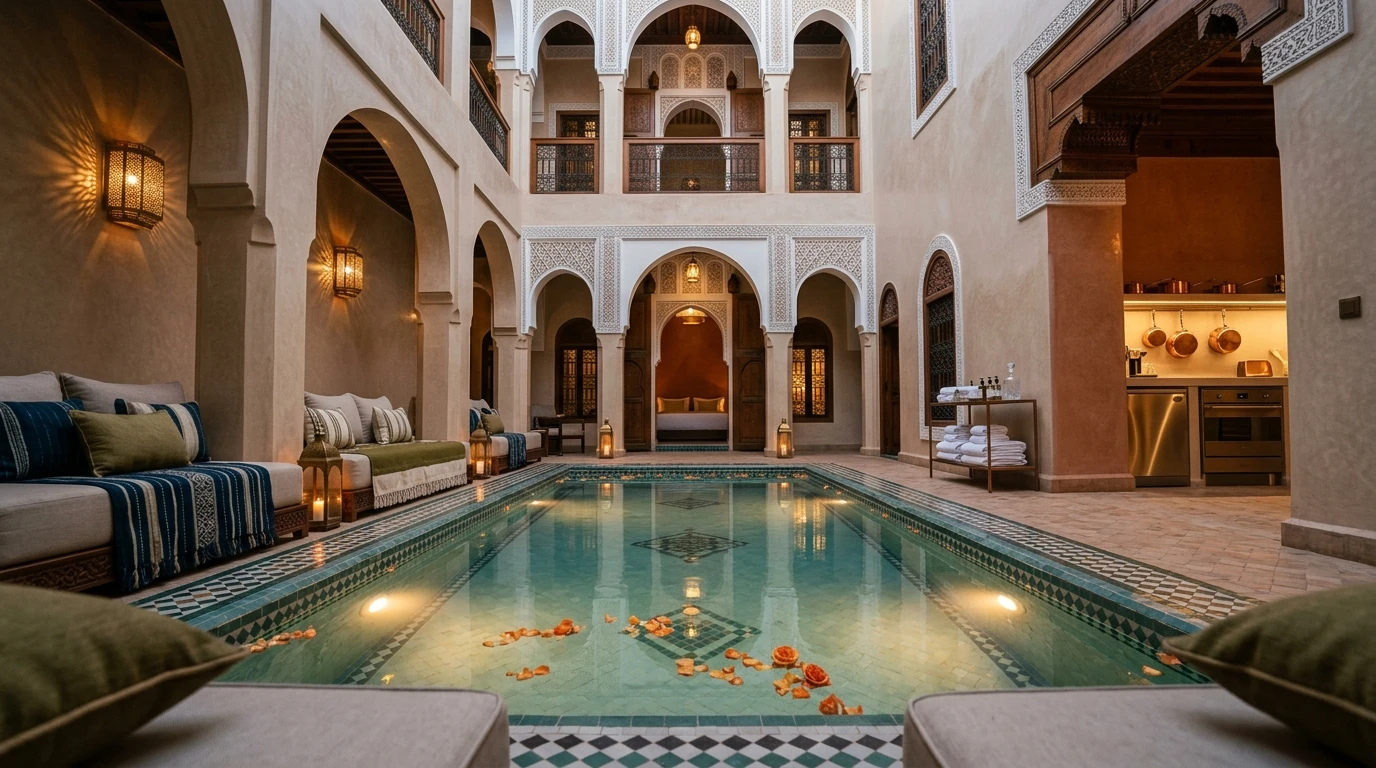
- Finishes: zellige, tadelakt, joinery, flooring and traditional decorative features, which contribute to the commercial value of a riad positioned in the luxury guesthouse segment at Marrakech.
- Furniture and home décor: furnishings for the rooms, communal areas, patio and terrace, often sourced directly from local craftspeople.
Costs that are often overlooked
There are three categories of expenditure that are frequently overlooked in project leaders’ initial estimates: costs relating to operating licences and classification, the recruitment and training of staff prior to opening, and launch marketing. The latter includes establishing an online presence and listing the property on booking platforms. Although these items are less visible than building works, they often determine the establishment’s ability to quickly achieve a viable occupancy rate.
Watch out
The budget for renovating a riad varies considerably from one project to another, depending on the initial structural condition, the number of bedrooms and the standard of finish required. Setting aside a contingency fund separate from the renovation budget allows you to cover unforeseen costs on site, which are particularly common when structural issues come to light once the walls have been opened up.
In summary, a comprehensive refurbishment budget comprises the costs of acquisition, building works, fit-out and launch. The safety margin must be determined on the basis of the actual condition of the building as revealed by the structural survey.
Renovation work and bringing the property up to hotel standards
The renovation work on a riad can be divided into two categories. On the one hand, there are priority structural works, which are essential to the building’s structural integrity and safety. On the other hand, there are finishing works, which determine the establishment’s market positioning.
Priority structural works
Underpinning the foundations, reinforcing load-bearing walls made of raw earth or rammed earth, and waterproofing the roof and terrace are among the works that must be carried out as a priority, before any decorative finishing work. These works are often underestimated at the time of the initial quotation. They can account for a significant proportion of the total budget, particularly where the building is several centuries old.
Fire safety and accessibility
The classification of a guest house in Morocco, now governed by Joint Decree No. 985-24 of 24 December 2024, imposes specific fire safety requirements: fire extinguishers, emergency exits, and materials that comply with fire performance standards. Accessibility for people with reduced mobility is also required, to the extent compatible with the layout of the historic building. These requirements are often difficult to reconcile with the traditional architecture of the riad, which features narrow staircases, raised thresholds and patios on multiple levels. They call for careful adaptation rather than the rigid application of standards originally designed for modern buildings.
At this stage, it is essential to work with a structural engineering firm and local contractors who are genuinely qualified in riad restoration. This is crucial to ensuring that the listing application ultimately meets the requirements, far more so than it is simply a matter of aesthetic quality.
Running a guest house: organisation and annual costs
Once the establishment has opened, its day-to-day running relies on a streamlined organisational structure: reception and concierge services, housekeeping and laundry, and catering if a food service is provided. Technical maintenance of the building remains crucial, as it is particularly affected by the climate and the age of the materials.
- Routine maintenance of the building (paintwork, tadelakt, waterproofing, plumbing)
- Local taxes and taxation relating to the hotel industry
- Insurance (public liability cover for business owners, building damage cover)
- Commissions charged by online booking platforms
Customer relationship management and monitoring online reviews have a direct impact on occupancy rates. An establishment with poor ratings on the main platforms sees its visibility reduced in search results, which automatically makes it harder to fill rooms during the low season. Some operators choose to join a Marrakech guesthouse association in order to pool some of their marketing visibility, share best management practices and collectively exert influence in discussions with local authorities.
In terms of operating models, there are two main options shaping the market. Direct management, where the project owner handles day-to-day management themselves, and independent management, where operations are delegated to a specialist operator in return for a fixed or variable fee. Operating a self-catering guest house with 1 bedroom and 1 bathroom enables the owner to retain the legal structure and the licence, whilst entrusting day-to-day management to a third party. This option is often chosen by investors residing outside Morocco.
Break-even point and net return: how can you assess the viability of the project?
The break-even point for a guesthouse refers to the number of overnight stays sold at which point the annual fixed costs are covered by the profit margin generated on each overnight stay. Until this threshold is reached, the establishment operates at a loss, regardless of the quality of its décor or its location.
Calculating your break-even point
The calculation method is based on a simple division. You divide the annual fixed costs (staff, maintenance, insurance, taxes, possible repayment of a loan) by the net margin generated per night. This margin corresponds to the average rate received, less the variable costs directly associated with accommodating an additional guest, such as linen, breakfast or platform commission. The result obtained corresponds to the minimum number of overnight stays that must be sold over the year to break even. There is a direct link to the occupancy rate: the higher the room capacity, the greater the number of overnight stays that need to be sold to cover fixed costs in absolute terms. The required occupancy rate, expressed as a percentage, may remain stable or decrease due to economies of scale on certain cost items.
Gross return vs net return
The gross return on a riad converted into a guest house is calculated by dividing the annual turnover by the total investment, including the purchase price and renovation costs. The net return, on the other hand, deducts from this turnover all operating costs, applicable tax and, where applicable, the cost of outsourced management: this is the only truly relevant indicator for assessing the profitability of a riad on a Marrakech basis. The difference between the two can be significant, either way, depending on the specific cost structure of each property. It is therefore better to focus on net yield rather than the gross yield advertised when a property is being marketed.
When I’m reviewing a proposal to take over a riad, I always start by looking at the realistic occupancy rate rather than the nightly rate advertised on competing platforms: it is this figure, not the list price, that determines whether the break-even point is actually achievable.
Claire Emeriau
Key points to remember
The break-even point is calculated by dividing the annual fixed costs by the profit margin generated per night. Net return, which takes into account operating costs and tax, remains the only reliable indicator for assessing the viability of a project to convert a riad into a guesthouse. These two indicators vary significantly depending on the location, the size of the establishment and the quality of the management in place.
Pitfalls to avoid and tips for a successful transformation
In the projects examined, budget underestimation remains the most common pitfall for project owners. An initial quote drawn up without a prior structural assessment is almost invariably revised upwards as soon as the first walls are knocked down.
- Buying without a structural survey: an old riad may conceal defects that are not apparent during a standard viewing.
- Launching the business without a classification or a valid tourism licence: Operating a riad with one bedroom and one bathroom without a valid tourism licence exposes the business to the risk of administrative closure and deprives it of any official recognition by tourism organisations.
- Underestimating the actual time between purchase and opening: this timeframe includes not only the duration of the construction work, but also the time taken for the administrative procedures relating to the licence and classification, two processes that do not necessarily run concurrently.
- Neglecting professional support: Enlisting the help of a local architect familiar with traditional building methods and seeking legal advice right from the feasibility stage makes it possible to identify potential stumbling blocks before making a financial commitment, rather than afterwards.
A riad converted into a Marrakech guesthouse remains, above all, a business venture rather than merely an architectural project. Its viability is judged by the consistency between compliance with the legal framework, the budget actually committed, and the establishment’s ability to reach, night after night, the threshold beyond which the business becomes genuinely profitable.
FAQ
What budget should you allow for converting a riad into a Marrakech guest house?
The total budget comprises the purchase price, structural and finishing works, furnishing costs, as well as licensing, recruitment and launch marketing costs. The amount varies considerably depending on the riad’s initial structural condition, the neighbourhood and the intended number of rooms, which makes a preliminary structural survey essential before any final cost estimate can be drawn up.
What legal structure should you choose for running a guesthouse in Morocco?
A limited liability company (SARL) or its single-member variant, the SARL AU, is the recommended legal form in Morocco for operating a riad converted into a guesthouse, as it combines management flexibility, administrative credibility and limited liability for the operator.
What licences are required to open a guest house in Marrakech in 2026?
Opening a business requires obtaining a tourism operating licence, issued in accordance with the provisions of Decree No. 2-23-441 of 13 July 2023, as well as a classification in accordance with Joint Order No. 985-24 of 24 December 2024. These two procedures, which are distinct but complementary, are in addition to the registration of the legal entity, whether a SARL or a SARL AU.
How long does it take to break even on a riad converted into a guesthouse?
The payback period depends directly on the actual occupancy rate achieved and the difference between the annual fixed costs and the profit margin per overnight stay. It is calculated on a case-by-case basis using each establishment’s specific break-even point, rather than on the basis of a standard period applicable to the market as a whole.
What is the difference between a riad, a guesthouse and a rated hotel?
The term ‘riad’ refers to the architectural style of the building – a dwelling organised around a courtyard – whilst ‘guesthouse’ and ‘classified hotel’ refer to distinct categories of tourist accommodation, governed by Law No. 80-14. A guesthouse offers limited accommodation capacity in a building of distinctive architectural character, whereas a classified hotel is subject to a star-rating system specific to establishments with greater capacity.
Is it possible to convert a riad into a self-managed guesthouse with Marrakech status?
Yes: the owner retains the legal structure, the tourism licence and the establishment’s classification, whilst entrusting day-to-day operational management to a specialist operator under a management contract without ownership, an option frequently chosen by investors who do not reside in Morocco.