
The Moroccan property market attracts many investors, but the increase in land disputes and hidden defects highlights the importance of increased vigilance. To secure your property purchase in Morocco, pitfalls and legal uncertainties must be anticipated through a rigorous check of titles and planning permissions. We have designed this guide to help you identify invisible risks, from the specificities of the Melkia to delivery guarantees, so that you can serenely protect your capital.
Real estate pitfalls in Morocco: the land title issue
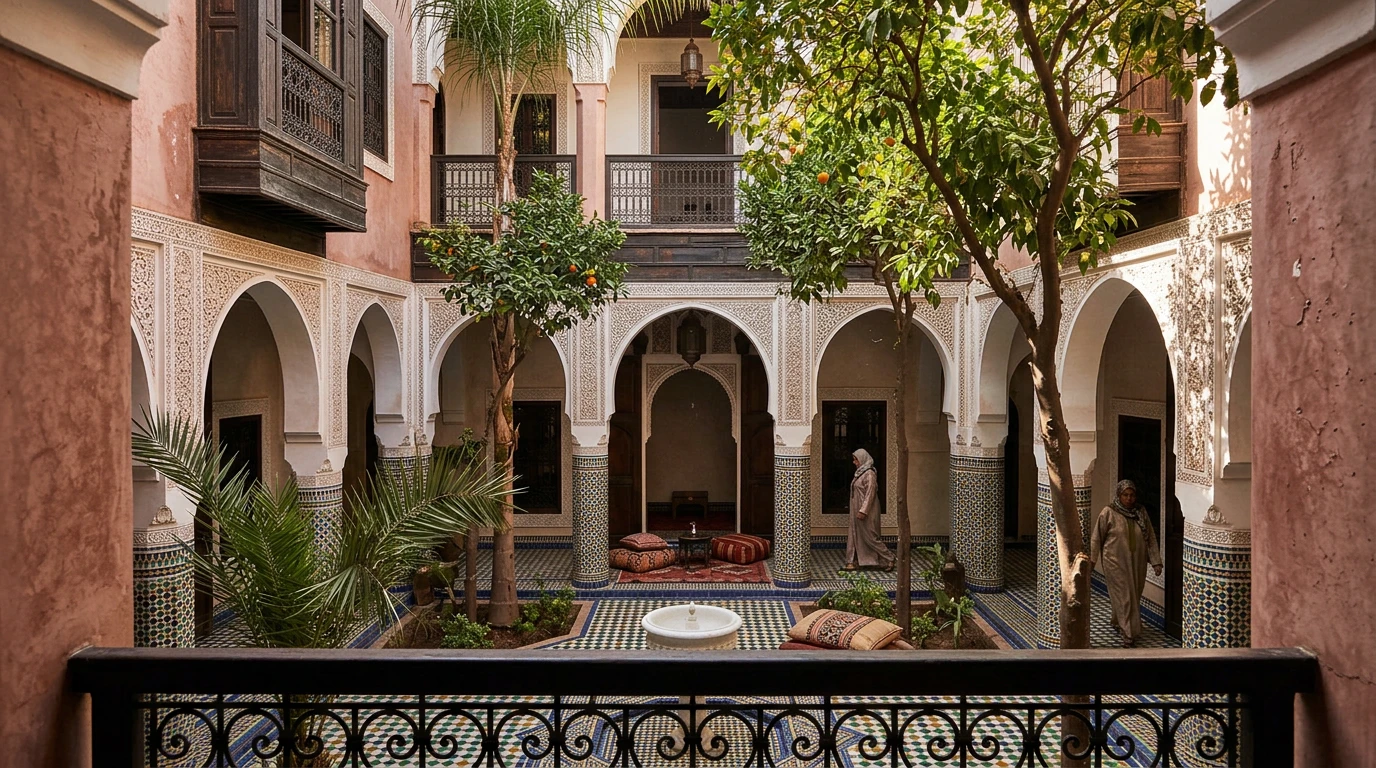
After dreaming of patios and zelliges, legal reality quickly catches up with you if you don't understand the nature of the title deed.
Distinguishing between a freehold title and a simple 'Melkia'
The land title deed guarantees definitive registration and absolute security. Conversely, the Melkia relies on notarised testimonies. This customary status exposes buyers to family disputes during complex successions.
Converting a Melkia into a land title is a long and costly process. For a foreign investor, this administrative procedure is an often risky step. An untitled riad may hide completely unknown heirs, blocking the sale. This is particularly true of riads in the Medina where successions are often complex.
Check with the Land Registry for encumbrances
Ordering a recent certificate of ownership is a vital reflex. This official document lists the current owners and mentions any charges encumbering the property. It allows for the identification of bank mortgages or judicial pre-notes indicating disputes.
- Exact area check.
- Identity of rights holders.
- Encumbrances or seizures.
Delivery and compliance risks in off-plan sales
While new builds may seem more reassuring, off-plan sales (VEFA) have their own contractual grey areas.
Require a robust guarantee of completion of works
Moroccan law strictly regulates VEFA to protect the purchaser. The developer must provide a bank guarantee or insurance covering completion of the building work. Discover our off-plan projects in Marrakech that comply with all these guarantees.
Without this guarantee, you risk losing your deposits if the developer goes bankrupt. Always check that the preliminary contract explicitly mentions these financial protection measures.
Legal point of attention
Never disburse funds outside the legal payment schedule provided for by the Code of Obligations and Contracts.
Control the validity of building permits
A developer can alter plans without your explicit agreement. Scrupulously compare the submitted building permit with the reality of the work on site.
The absence of a habitation permit at the end of construction prevents the individual registration of the flats. This is a major administrative blockage for the future resale of the property.
Ensure that the materials correspond to the technical specification annexed to the sales contract. Unpleasant surprises often occur during the finishing stages of the construction site.
| Element | Risk |
| Guarantee | Loss of deposits |
| Residence permit | Resale impossible |
Notary fees and local taxes
As with any property acquisition, the purchase price is accompanied by additional costs, including in particular notary fees and local taxes, which contribute to the overall cost of the investment.
Calculate registration fees and professional charges
The property acquisition immediately triggers the payment of registration fees amounting to 4%. In addition to the notary fee and land registry fees, this step helps to ensure a perfectly secure acquisition.
| Expenditure post | Estimated rate or amount | Beneficiary |
| Stamp duty | 4% | State (Public Treasury) |
| Land conservation | 1.5% + 200 DHS | ANCFCC |
| Notary fee | 0,5% | State |
| Notary fees (excluding VAT) | 0.5% to 1% | Notary |
| VAT on fees | 10% | State |
Notary fees are now regulated by decree in Morocco. They generally range between 0.5% and 1% depending on the value of the property. We advise you to request a precise breakdown from the outset.
Anticipating the residency tax and ongoing charges
Becoming a homeowner naturally involves certain recurring charges, starting with the council tax, the amount of which is determined based on the rental value of the property established by the tax authorities.
In addition to this, there is the municipal services tax, as well as, where applicable, co-ownership charges. In high-end residences, the latter can be more significant due to the level of maintenance and the services offered.
It is therefore recommended to anticipate these elements in your overall budget and to ensure, before acquisition, the perfect regularity of the seller's payments. Obtaining a clearance certificate from the managing agent is, in this respect, an essential step to approach the transaction with peace of mind.
Technical hidden defects in Medina riads
The charm of centuries-old walls sometimes hides structural pathologies that only an expert eye can detect.
Diagnose the watertightness and structural integrity of the structures
Old riads often have structural specificities linked to their traditional construction, notably rising damp in adobe walls. This moisture can, over time, weaken certain load-bearing parts, such as the base of columns. A close examination of these elements is therefore essential.
In the same way, the waterproofing of terraces is a recurring point of attention. Inadequate management of rainwater can impact ceilings and underlying structures.
Finally, observing cracks, particularly on the load-bearing walls of the patio, makes it possible to identify potential structural movements or unevenly distributed stresses.
In this context, the use of experts such as a design office and a specialised laboratory is not only recommended, but truly decisive. Their analysis makes it possible to validate the structural integrity of the structure, to objectify any potential defects, and to approach each project with a level of requirement and safety commensurate with the investment.
Watch out
Check for rising damp, terrace waterproofing, and patio cracks.
Consult our guide to prices per m² in Marrakech to assess whether the cost of renovation remains consistent with the value of the neighbourhood.
Engage a technical expert before finalising the agreement
Calling in a specialist design office or architect is a worthwhile investment. They will test the electrical network and plumbing, which is often outdated. Our agency systematically recommends this stage to secure your project.
In the event of discovering hidden defects after the sale, legal recourse in Morocco is complex. You will need to prove that the seller was aware of the defect and intentionally concealed it. Rigorous technical expertise will therefore be essential.
Checkpoints
- Condition of the roof structure
- Electrical compliance
- Water pressure
- Thermal insulation
The financial danger of undeclared cash payments
The temptation of «off-the-books» transactions remains present in some deals, but the risks involved far outweigh any superficial savings.
Refusing bribes to protect one's capital
Paying part of the price in undeclared cash exposes you to severe tax adjustments. The Moroccan tax authorities use reference price grids to detect obvious under valuations. We advise the utmost caution.
In case of resale, you will pay a capital gains tax calculated on an artificially low purchase price. Your actual gain will be heavily reduced. It's a losing calculation from the start.
This undeclared payment offers you no legal guarantee in the event of the sale being cancelled. You will never officially recover the sums paid under the table. Only the declared price is protected.
Using a convertible dirham account for security
For non-residents, opening a convertible dirham account is a mandatory step. This guarantees the future repatriation of sales proceeds and capital gains. It is the foundation of your security.
Secure your repatriation
Registration with the Exchange Office and the use of a convertible dirham account are compulsory. Keep every exchange slip as proof of the origin of the funds.
The funds must come from a registered international currency transfer. This traceability is your only protection against administrative blockages when transferring abroad. Everything must be perfectly clear.
Keep all exchange slips and bank credit advices carefully. These documents are essential to justify your initial investment.
Overpricing due to a lack of market research
Buying on impulse is the best way to overpay for an asset that isn't worth the price.
Compare actual prices charged in sought-after neighbourhoods
Prices per square metre vary enormously between the Medina, l'Hivernage or the Palmeraie. Don't rely solely on online advertisements, which often show overpriced properties. We've found that the discrepancies can be brutal.
Contact several local estate agents to get actual transaction prices, not asking prices. The negotiation margin can sometimes reach 20 %. This is a ground reality that you must incorporate.
Here are the points we analyse to set a fair value:
- Proximity to car access
- Calm of the alley
- Status of neighbouring riads
- View of the Atlas
Assessing resale potential according to urban projects
The arrival of new infrastructure, such as car parks or pedestrian areas, directly influences future value. Find out about the city's urban development plans. Anticipating these changes is a major asset.
A rental investment should be based on a realistic occupancy rate, not on promises of exceptional returns. Always deduct management and maintenance costs from your calculations. Be pragmatic in your financial projections. Use our riad profitability calculator for reliable projections.