In brief: A foreigner may buy a riad urban development in the Medina of Marrakech, subject to verification of the status of the land title, compliance with the foreign exchange rules applicable to the financing, and provision for registration fees, which are due to change on 1 July 2026.
Buying a riad in the Medina appeals to a wide range of people: those looking for a charming home, those planning to make a life in Morocco, or those pursuing a tourist rental strategy. Before signing, four points warrant careful verification: the exact nature of the property, the soundness of its title, the chosen financing arrangement and, where applicable, the operating regulations governing a commercial activity.
The riad in the Medina of Marrakech: what exactly are we talking about?
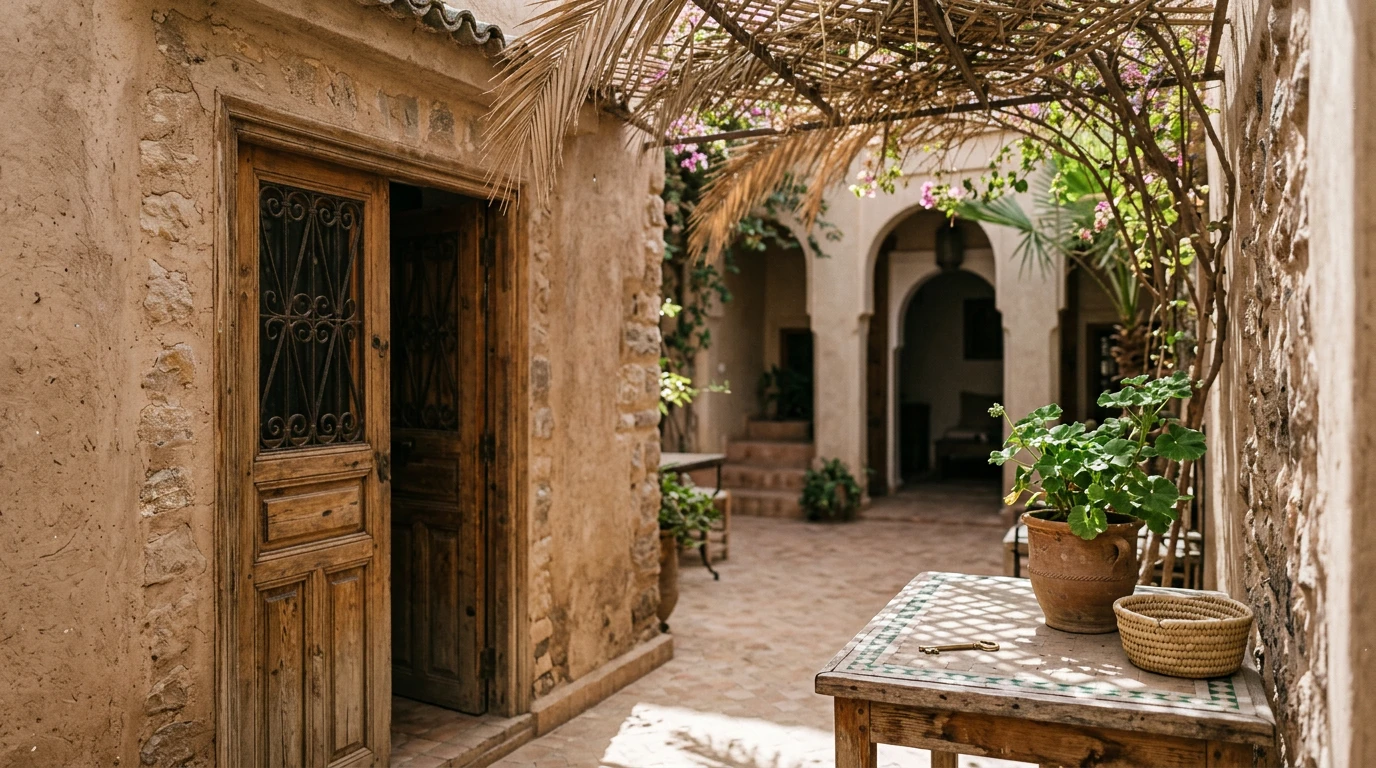
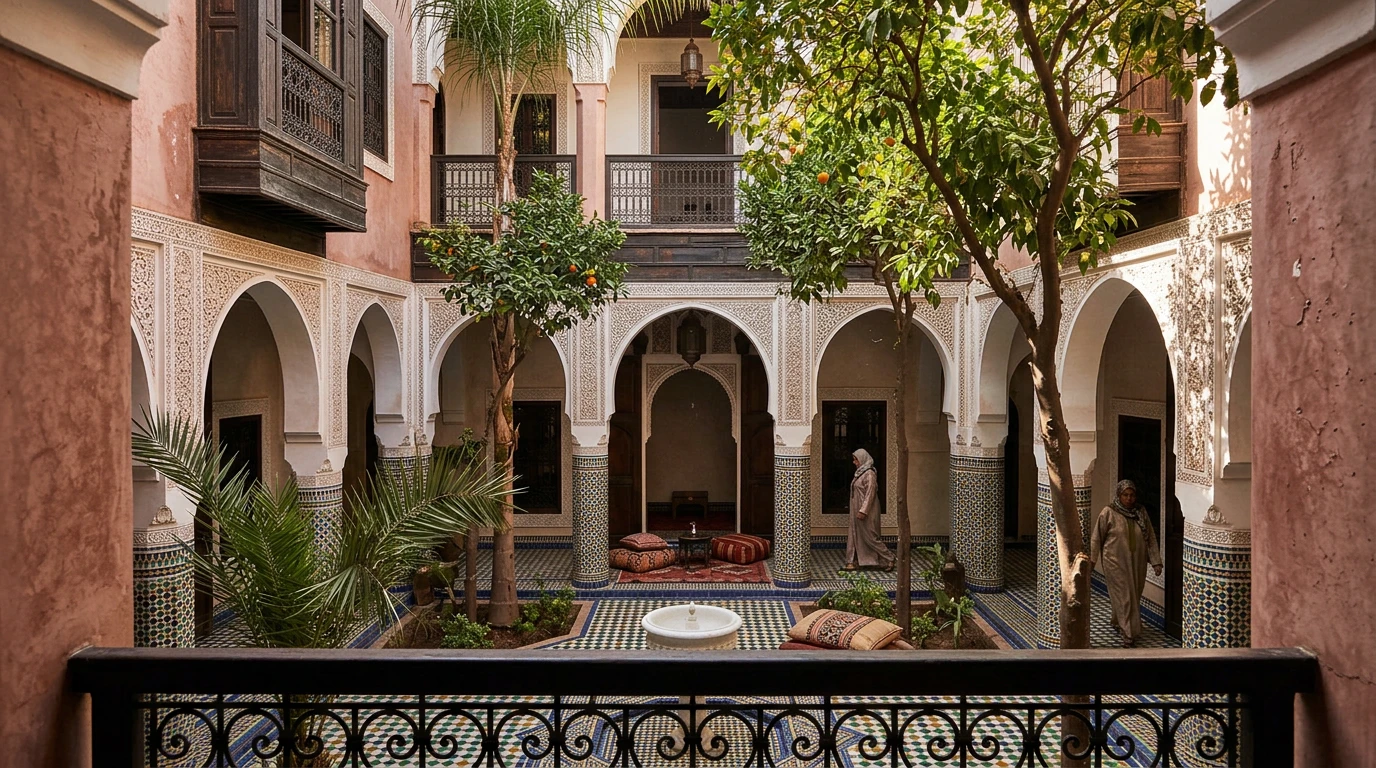
A riad is a traditional Moroccan house organised around a central courtyard, often planted with fruit trees or featuring a pond, onto which all the living areas open. This layout, centred on an inner courtyard, distinguishes the riad from other types of traditional dwellings found in the Medina.
Riad, dar, guesthouse: the subtle differences you need to know
La dar refers to a traditional house similar to a riad in that it is laid out around a courtyard, but without a landscaped garden: the central space is usually paved. The guest house is not an architectural classification but a type of business operation: it is a riad or a dar that has been converted into a commercial tourist accommodation establishment, which requires authorisations separate from those relating to simple ownership of the property.
The Medina, an area listed as a World Heritage Site since 1985
La medina refers to the historic urban fabric of a Moroccan city, usually surrounded by ramparts, where souks, mosques and traditional dwellings are concentrated. A riad is therefore not synonymous with a medina: it is an architectural style found within this urban fabric, alongside dars, fondouks and shops.
The Medina of Marrakech is listed on the a UNESCO World Heritage Site since 1985. This designation underpins the entire framework of protection applicable to the assets located there, through a Architectural Charter for the Medina designed as a means of preserving architectural, urban and landscape heritage. The purchase of a riad cannot therefore be separated from the regulations governing its restoration or conversion, a point discussed in more detail later in this article.
Can a foreigner buy a riad in the Medina of Marrakech?
Yes: the’purchase of a property is expressly listed amongst the forms of foreign investment permitted in Morocco. According to the Foreign Exchange Office, the acquisition of immovable property or rights of use attached to such property is one of the transactions recognised as foreign investment, which in principle covers the purchase of an urban riad in the Medina.
However, one restriction must be ruled out before any commitment is made: a foreign national cannot purchase a property in agricultural land situated outside the urban area, including through a company. This restriction, as reiterated by the National Council of the Moroccan Notaries’ Association, does not, in principle, apply to an urban riad in the Medina. It does, however, require verification of the property’s exact land status, particularly if it includes an outbuilding or an adjoining plot of land whose agricultural status has not been lifted.
This eligibility in principle does not exempt the transaction from the property, tax and foreign exchange rules governing it. In particular, the buyer’s status as a resident or non-resident affects the terms of financing and the transfer of funds, which are examined below.
Financing the purchase and ensuring the secure transfer of funds
The financing method you choose directly determines the freedom you will subsequently have to repatriate your rental income or the proceeds from a resale. There are two approaches: financing in foreign currency from abroad and a Moroccan bank loan in dirhams.
Foreign currency financing and repatriation of funds
A foreign investment financed in foreign currency benefits from the convertibility regime: this includes the freedom to transfer income generated by the asset and the proceeds from its sale or liquidation. This guarantee, provided for in the General Instructions on Foreign Exchange Transactions, is subject to the retention of bank statements certifying the foreign-currency origin of the funds invested.
Moroccan loans for non-residents: the 80 % limit
A non-resident foreign individual may also apply for a Moroccan bank loan in dirhams for the purchase of a home. This funding is capped at 80 % of the property’s price; the balance must be settled in accordance with the applicable foreign exchange rules, generally by making a payment in converted foreign currency. The criteria for accepting an application vary from one Moroccan bank to another and are not standardised by the foreign exchange regulations themselves.
Before finalising any agreement, it is advisable to confirm the chosen financing arrangement with the bank and the notary, whether it involves financing entirely in foreign currency, a dirham loan at 80 %, or a combination of the two.
Good to know
Foreign-currency financing and dirham loans at 80 % are not mutually exclusive: a buyer may combine a foreign-currency deposit with a Moroccan loan, provided that each payment is documented separately to preserve the freedom to transfer funds at a later date.
Check the title to the property before signing
For a block of flats registered, that is to say, once recorded in a land register held by the Land Registry, the real right of ownership is only enforceable against third parties from the date of its registration in that register. Signing a deed of sale is therefore not sufficient: until the transfer has been registered with the Land Registry, a third party may, in certain circumstances, assert a competing claim to the same property.
Registered land title, melkia, joint ownership: what this means
The land title is the document that legally identifies a registered property and its right holders: it serves as the sole, legally binding reference in the event of a dispute. Conversely, a melkia is a traditional title deed, issued prior to or at the same time as registration, which does not enjoy the same safeguards regarding third-party effect until the property has been registered.
In the Medina, complex land tenure situations remain common: properties held under the ‘melkia’ system that have never been registered, registration procedures currently underway, joint ownership amongst heirs, or encumbrances on the title. None of these situations can be deduced from a simple advertisement: they require a case-by-case verification, carried out by a notary and directly with the ANCFCC (the National Agency for Land Registration, Cadastre and Cartography).
In the riad purchase cases we handle, the issue of joint ownership arises more often than one might imagine: a property sold by a single heir, whilst others hold a share in it, cannot be validly transferred without their formal consent. This is precisely what a preliminary land title check helps to prevent.
Claire Emeriau
The documents required to register a full transfer of ownership
To register a total transfer With regard to a land title, the ANCFCC requires, in particular: a valid deed of transfer, an application for registration, an administrative authorisation or certificate where the circumstances so require, and a duplicate of the land title held by the seller. These documents form part of the land registration procedure itself; they do not exempt the parties from separately verifying the absence of encumbrances, existing planning permissions or the property’s tax status.
It is recommended that you do not Never pay a deposit before obtaining this land title verification in writing, in the form of a recent title certificate and a reasoned opinion from the notary handling the case.
Fees, registration charges and taxation to be budgeted for in 2026
The budget for buying a riad is never limited to the price quoted in the advert. Three additional charges are always added: the land registry fee levied by the ANCFCC, registration fees, and, since 1 July 2026, an additional surcharge once the price exceeds a certain threshold.
| Expense item | Rate or amount | Basis and condition |
|---|---|---|
| Land retention rights | 1.5 % + a fixed amount of 100 DH (minimum 500 DH) | Full transfer recorded in the land register, ANCFCC tariff |
| Stamp duty | 4 % (reference rate) | Premises built for residential, commercial, professional or administrative use; rate to be confirmed by the solicitor |
| New registration fee | + 2 points | Transfers of immovable property or rights in rem exceeding 300,000 DH, where the deeds are drawn up on or after 1 July 2026 |
Source: ANCFCC (fees and timeframes), National Council of the Order of Notaries of Morocco, Finance Act 2026. Data accessed on 15 August 2026.
The new registration fee of 2 %, effective from 1 July 2026
The 2026 Finance Act introduces an additional registration fee of 2 points, applicable to deeds and agreements drawn up on or after 1 July 2026. It relates to transfers of immovable property and rights in rem in respect of which the price exceeds 300,000 DH, which covers virtually all riads sold in the Medina. For any purchase exceeding this threshold, it is necessary to confirm in advance the chosen method of payment and its traceability through the banking system, before signing the preliminary sale agreement.
Why a written notarial simulation is essential
The exact rate of charges applicable to a particular acquisition depends on the chosen structure (direct purchase of the property, purchase of shares in a company that owns the property, joint ownership) and the terms of payment. It is recommended that you obtain a notary’s written simulation before agreeing to any deal, rather than relying on a flat-rate percentage quoted by an intermediary.
Key points to remember
A realistic purchase budget includes the price of the riad, the land registry fee, registration fees and, since 1 July 2026, a 2-point surcharge on amounts exceeding 300,000 DH. Only a written notarial estimate can determine the final amount.
Renovating a riad in the Medina: planning permission and heritage restrictions
Any operation involving restoration, refurbishment, renovation or new-build Any work carried out in the Medina must be subject to a prior application for authorisation. These stricter controls stem directly from the site’s heritage status, which is protected by its World Heritage listing and governed by the Architectural Charter mentioned earlier.
A project involving a swimming pool, a roof extension, the cutting through of a load-bearing wall or the creation of a terrace cannot be taken for granted at the time of purchase: its feasibility must be verified before making the decision to purchase contingent on this programme of works. In many cases, a preliminary agreement signed subject to the condition precedent of obtaining planning permission remains the most prudent approach.
The use of local craftspeople trained in traditional techniques (zellige, tadelakt, gebs) makes it easier to obtain planning permission, as the planning process takes into account the project’s compatibility with the heritage context, and minimises the need for subsequent repairs caused by materials unsuitable for historic buildings.
Running a riad as a guest house or tourist accommodation
Buying a riad and operating it commercially as tourist accommodation are two separate processes, subject to different regulations. The purchase alone does not in any way constitute authorisation to accommodate paying guests.
A tourist accommodation establishment must first obtain a operating licence, and then be the subject of a ranking. Once open to the public, the operator must give notice of this opening within 60 days. These requirements apply regardless of whether the property is a riad, a dar or any other type of building converted into accommodation.
The applicable framework has recently been updated: a Joint Order of 24 December 2024, published in the Official Gazette on 27 May 2025, sets out new classification standards for tourist accommodation establishments. This legislation repeals the previous standards from 2003, with the exception of those relating to camping. Any riad project intended for organised tourist lettings must be assessed against this updated set of standards prior to purchase.
Watch out
The fact that a riad is advertised as being ready to operate as a guesthouse does not mean that the operating licence and classification have already been granted. These statuses are linked to the operator and the establishment, not to the property itself: they must be verified separately from the deed of sale.
What are the prices of riads in the Medina of Marrakech in 2026?
On the Domio property listing portal, a search carried out in August 2026 revealed a average asking price of 38,198 DH per square metre for the riads in Medina district, based on a sample of 19 listed properties. This figure represents the asking price set by sellers or estate agents, not a notarised sale price: it provides an indication of the price range, not a basis for valuation.
The wide range of listings observed illustrates this limitation. A 200 m² riad might be advertised at 4,500,000 DH, whilst a 600 m² riad cost 37,800,000 DH. The difference cannot be explained by floor area alone: the condition of the property, the specific neighbourhood, access (pedestrian only or proximity to vehicle access) and the type of use often have a greater impact on the price than the number of square metres.
This listing information is no substitute for local expertise based on properties that have actually been sold. Before making an offer, it is still advisable to seek the advice of a property professional based in Marrakech, who can assess the property in the context of transactions that have actually taken place.
Which neighbourhood in the Medina should you choose when buying a riad?
The choice of neighbourhood depends first and foremost on the type of property: a quiet home, a second home, or guest house which attracts large numbers of tourists. Several areas of the Medina regularly feature in buyers’ searches.
The most sought-after neighbourhoods in the Medina
- Mouassine: a neighbourhood popular for its lively yet orderly atmosphere, its designer shops and its relative proximity to Jemaa El Fna Square.
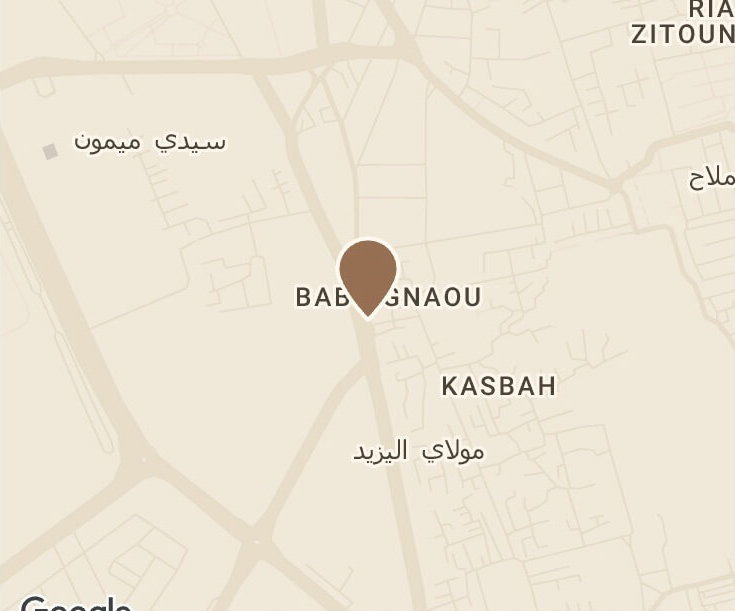
- The Kasbah: a historic area close to the Royal Palace, known for being more residential and generally quieter than the commercial heart of the Medina.
- Riad Laarouss: a neighbourhood to the north of the Medina, often described as more authentic and less touristy, with access by car sometimes easier.
- Dar El Bacha: right next to the museum of the same name, with a distinct sense of heritage, and narrow, mostly pedestrianised streets.
- Bab Doukkala Gate: a lively neighbourhood with a daily market, popular for its authenticity and prices that are sometimes more affordable.
- Kennaria: a central, lively neighbourhood, close to the souks, ideal for a commercial venture or a guesthouse in a high-footfall area.
- Riad Zitoun Kedim and Riad Zitoun Jdid: historic thoroughfares linking Jemaa El Fna to the Badiî Palace, which are very busy and feature a high concentration of shops at ground floor level.
This choice of neighbourhood must always be cross-checked against the land and property checks already mentioned: a sought-after location never makes up for an uncertain title or a missing planning permission. To date, there are no reliable figures available to establish an average price per neighbourhood: the variations observed in property listings reflect the diversity of properties rather than a stable hierarchy between areas.
Pitfalls to avoid and practical advice for shopping with peace of mind
Beyond the charm of a riad visited on a summer’s day, there are certain points to bear in mind that consistently crop up in property purchase files. A thorough check before signing the contract minimises the risk of unpleasant surprises after the deed has been signed.
- Land title status: registered, melkia, or registration pending, with a confirmed absence of encumbrances or unresolved co-ownership.
- Planning permission already obtained or required for the proposed refurbishment programme.
- Classification status if a tourist business is planned, checked against the standards in force since May 2025.
- Practical access to the riad: carrying of materials, proximity to a vehicle access point for deliveries and any subsequent work.
- A realistic renovation budget, separate from the purchase price, particularly for a riad sold in need of renovation.
Seeking support from a Moroccan notary From the moment the preliminary agreement is signed, and through a local solicitor in the case of complex arrangements (property investment companies, joint ownership, mixed financing), this remains a valuable guarantee of legal certainty. No average price listed on a property portal should replace a comparison of the property’s actual characteristics: usable floor area, condition, access and occupancy status carry more weight than a mere reference to price per square metre.
Buying a riad in the Medina of Marrakech remains a viable option for a foreign buyer, provided they address, in the correct order, the exact nature of the property, the security of its title, the chosen financing arrangement and, where applicable, the intended tourism operating regime. It is this sequence of checks, rather than the charm of the courtyard or the view from the terrace, that determines the long-term viability of the project.
FAQ
Is it possible to invest in a riad with one bedroom and one bathroom?
Yes. According to the Foreign Exchange Office, the purchase of property is one of the forms of foreign investment permitted in Morocco. This involves checking the title deed, the financing and, in the case of tourist rental properties, the operating licence.
Can a French national buy a property in Morocco?
Yes, a French national may purchase urban property in Morocco, including a riad in the Medina of Marrakech. Only land designated for agricultural use located outside urban areas is excluded from this option.
What is the difference between a medina and a riad?
The medina is the historic urban fabric of a Moroccan city, surrounded by ramparts. The riad is an architectural style – a house with a central, landscaped courtyard – found within this urban fabric, alongside other buildings.
Which is the best neighbourhood in the Medina of Marrakech?
There is no single neighbourhood that is universally better: Mouassine, the Kasbah and Riad Laarouss each offer a different atmosphere – lively, residential or authentic. The choice depends on the project: a quiet residence or a guesthouse with plenty of footfall.
What is the best neighbourhood to buy a Marrakech property in?
Within the Medina, Dar El Bacha, Bab Doukkala and Kennaria are regularly mentioned by buyers, depending on their desired proximity to the souks and access for vehicles. There is currently no verified price data available by neighbourhood.
Is it worth investing in Marrakech?
The level of interest depends on the nature of the project – whether it is a residential property or a holiday let – and on the thoroughness of the checks carried out: title deeds, financing in accordance with foreign exchange regulations, and compliance with the heritage and operational rules specific to the Medina.