
In brief: Buy a riad with 1 bedroom and 1 bathroom remains open to foreign investors, in a highly segmented medina property market, ranging from 10,000 to 40,000 DH per square metre depending on the condition of the property (2026 figures), and funds contributed in foreign currency benefit from a convertibility regime guaranteeing their future transfer.
The riad market in the medina of Marrakech: prices and disparities
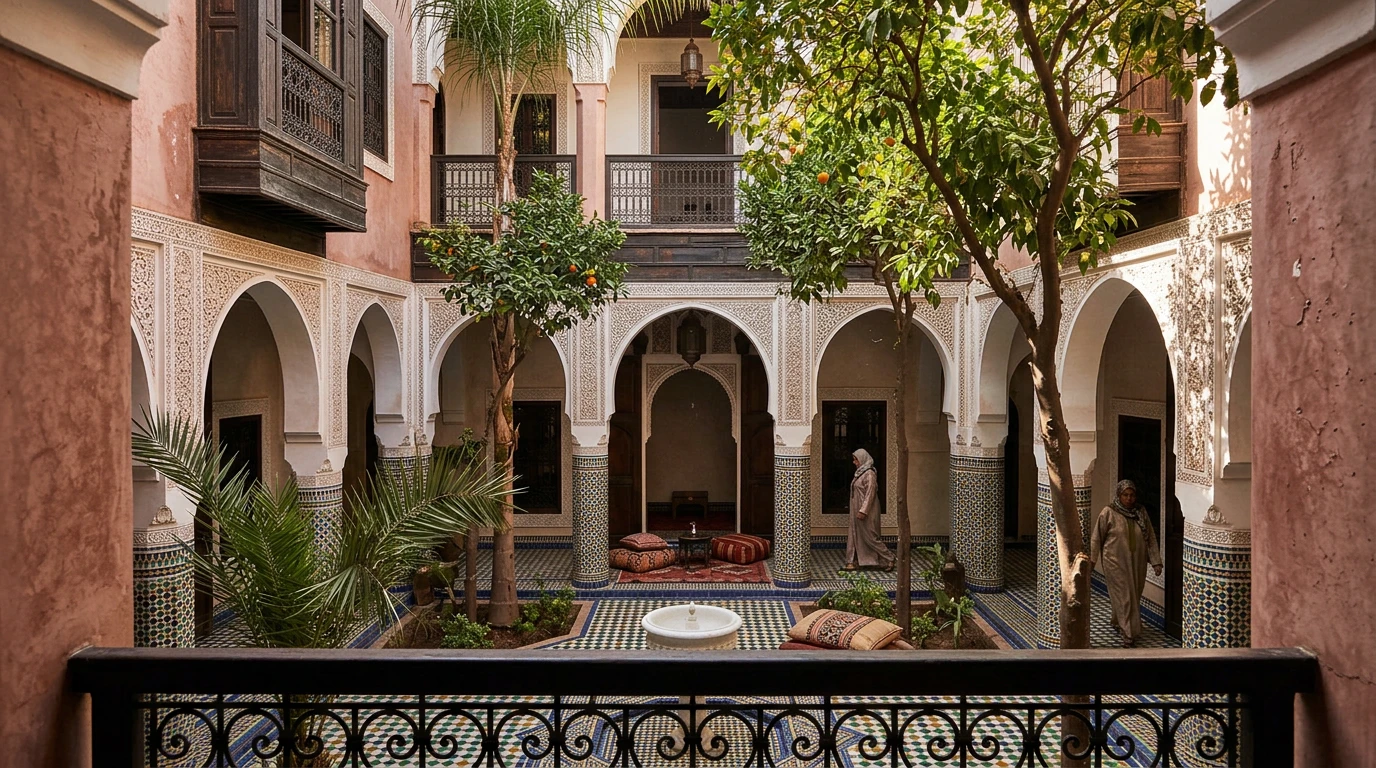
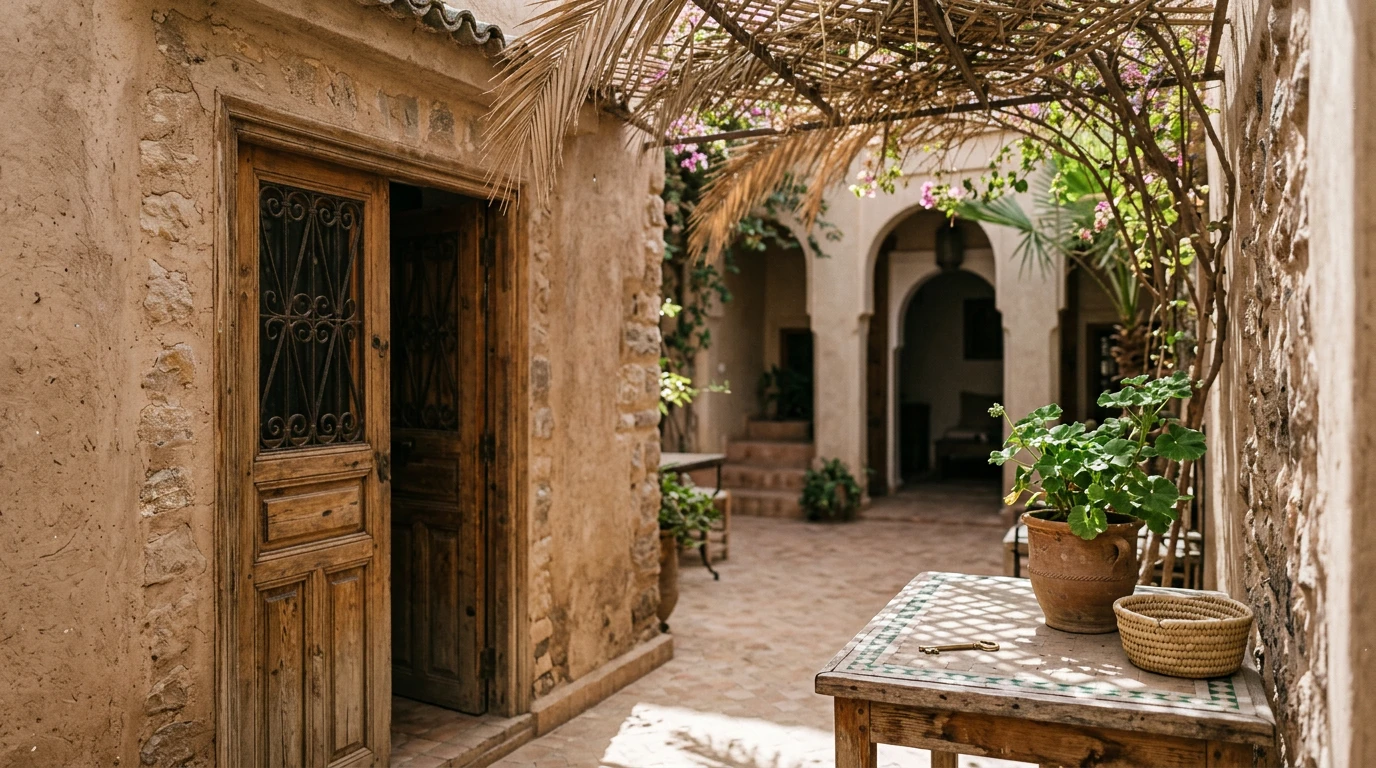
A riad is a traditional Moroccan house organised around an inner courtyard, often planted with orange trees or featuring a water feature, and laid out over several levels that are enclosed from the outside. In the medina of Marrakesh, this architectural style predominates amongst older buildings and accounts for the bulk of properties on the market.
Out of a sample of 19 riad advertisements recorded in the medina in August 2026, the average asking price stood at 38,198 DH/m². This average needs to be put into context: these are the prices advertised, not the actual sale prices recorded before a notary. The same riad may be sold for significantly less than its asking price, depending on the condition of the property, the level of supply in the relevant derb and the margin allowed by the seller.
Price per square metre: riad in need of renovation vs renovated riad
The market clearly distinguishes between two categories of property. For a riad in need of renovation, the indicative 2026 price range is between 10,000 and 25,000 DH per square metre. For a riad that has already been renovated, this range rises to between 15,000 and 40,000 DH per square metre.
| Condition of the riad | Indicative range for 2026 (DH/m²) |
|---|---|
| In need of renovation | 10,000 to 25,000 |
| Renovated | 15,000 to 40,000 |
Market benchmarks recorded in August 2026, to be compared with actual sales (data accessed on 4 September 2026). These ranges are indicative only and do not constitute official price lists.
Why two similar riads can have very different prices
The variation observed in the market far exceeds what can be explained by floor area alone. In the property listings examined in August 2026, a 200 m² riad was advertised at 4,500,000 DH, whilst a 600 m² riad was priced at 37,800,000 DH. The relationship between the two properties does not follow any simple rule of proportion.
There are several factors that account for these differences:
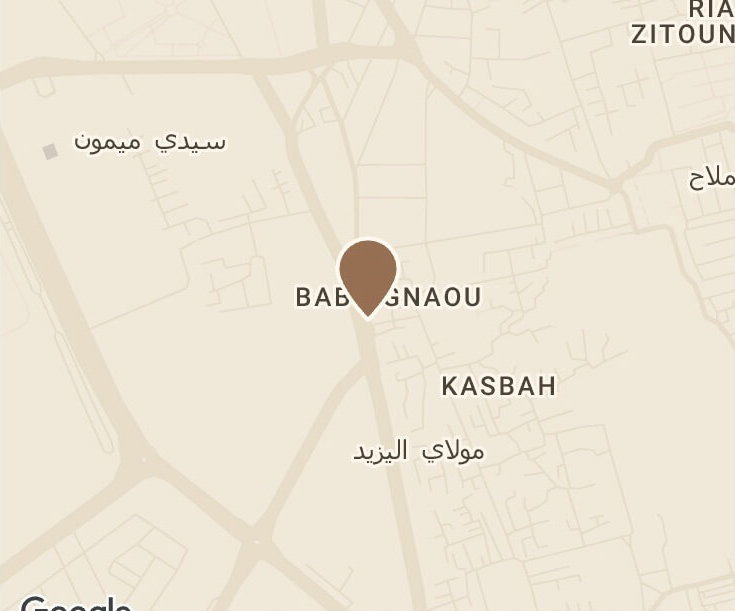
- The exact derb – that specific alleyway in the medina where the riad is situated – with some streets being far more sought-after than others;
- Access – on foot, by motorised delivery vehicle or, more rarely, by car – right up to the property’s doorstep;
- Its immediate proximity to the tourist and shopping centres of the medina;
- The quality of the refurbishment whether it has already been carried out, or whether it has not been carried out;
- The presence of an unobstructed view, a terrace or facilities such as a swimming pool or a steam room;
- The property’s commercial potential, which broadens the pool of potential buyers.
These price benchmarks, which are updated as transactions are recorded, never replace the need for a direct comparison with actual comparable sales recorded prior to any negotiations.
Riad: private residence or guest house – defining your business plan
A riad used as a private residence and a riad operated commercially as tourist accommodation are subject to two distinct legal regimes. The latter is governed by Law No. 80-14 and its implementing regulations, which establish a star-rating system for tourist accommodation establishments; since the publication of Decree No. 2-22-867 in the Official Gazette on 4 December 2025, construction or conversion projects must also comply with specific building standards.
The classification of riads operating as guesthouses
This classification applies to the commercial provision of accommodation, not to ownership of the property itself. A riad occupied by its owner as a residence is not automatically subject to this classification. It is the operation of the business – the provision of paid accommodation to guests – that triggers the obligation to be classified, not the act of purchase itself.
The applicable standards for facilities, operations and service vary depending on the type of establishment and the category in question: a riad classified as ‘Luxury’ does not meet the same specifications as a 3-star establishment.
The authorisation procedure with the CRI
Applications for provisional classification and operating authorisation must be submitted electronically to the Regional Investment Centre (CRI) with territorial jurisdiction, namely that of Marrakech for a riad located in the medina. The application pack includes, in particular, a certificate of compliance and a standards form corresponding to the type and category applied for.
Please note
Buying a riad does not automatically entitle you to accommodate paying guests there. The purchase of the property and its classification as a tourist accommodation are two legally distinct processes, which should be dealt with separately – ideally before the final contract is signed, if the business plan is a key factor.
An investor planning to operate a guest house It is advisable to undertake this classification process in parallel with securing the land title, rather than after the contract has been signed: certain adjustments required by the standards for the relevant category may result in changes to the works programme.
Building works and heritage: what UNESCO listing means for a property owner
The medina of Marrakesh has been a World Heritage Site since 1985. This status, awarded by UNESCO (the United Nations Educational, Scientific and Cultural Organisation), is accompanied by a system for the protection of the site and the assessment of construction and development projects.
What World Heritage listing means in practice
Any construction or development project in the medina is examined by the Regional Inspectorate of Historic Monuments and Sites, the competent authority which also monitors ongoing building works. This procedure does not constitute either an automatic grant of permission or a systematic refusal: it provides a framework for assessing applications according to the nature of the property and the proposed works.
Recommended structural inspections following the 2023 earthquake
Following the earthquake in September 2023, the report on the state of conservation of the medina, compiled in 2024, notes the collapse of seven sections of the ramparts. This finding relates to the state of conservation of the heritage site as a whole, not to each riad taken individually.
This does not mean that every riad in the medina has structural damage. Nevertheless, this observation justifies an independent survey before any commitment is made: the condition of the load-bearing structure, visible cracks, the roof, party walls and the quality of the work already carried out by previous owners.
Watch out
The Medina’s inscription on the World Heritage List in 1985 does not replace a structural survey of the specific riad in question. Having cracks, the roof and party walls inspected by an independent professional remains a separate step, distinct from the site’s heritage status.
Before drawing up a quotation or commencing a project, it is essential to systematically check, for the specific riad in question, its exact location, the nature of the work required and the specific requirements laid down by the relevant authority.
Choosing a riad: things to look for, neighbourhoods and pitfalls to avoid
The choice of a riad in the medina depends on a range of practical criteria, rather than simply on the size or the advertised price.
A checklist of specific criteria for assessing a riad
- Access to the property: on foot only, by motorised delivery, or, in exceptional cases, by car right up to the doorstep;
- The amount of light and the orientation of the patio, which are crucial in architecture that is closed off from the outside;
- The actual structural condition, verified independently of the seller’s statements;
- The status of the title deed and its consistency with the physical condition of the property;
- The potential for exploitation, should a commercial project be envisaged;
- Its close proximity to tourist hotspots and the busy thoroughfares of the medina.
These criteria align with the factors that drive property values in the market: the exact location, accessibility, proximity to tourist attractions, the quality of the refurbishment, the view, the facilities and the property’s current use all have a direct impact on where the property is positioned within its price range.
The most common pitfalls when buying
There are three mistakes that crop up time and again in riad purchase files:
- Confusing the price quoted in an advert with the actual transaction price: as mentioned above, the difference between adverts can still be considerable for properties of a comparable size;
- Failing to carry out an independent structural assessment, particularly in the post-earthquake context described above;
- To believe that simply purchasing the riad is sufficient to run it as tourist accommodation, without going through the process of classification and obtaining authorisation from the CRI.
Each of these traps have one thing in common: they make corrections before signing, rarely afterwards.
Ensuring a secure purchase: title deeds, legal due diligence and formalities
The role of the ANCFCC certificate of ownership
The certificate of ownership, issued by the ANCFCC (National Agency for Land Registration, Cadastral Surveying and Cartography), certifies the legal and physical status of the property at the precise moment the application is submitted. It does not constitute a guarantee that remains fixed over time: its informative value diminishes as the time elapsed since it was signed increases.
For this reason, it is best to raise this point shortly before the contract is signed, rather than early on in the negotiations.
The documents required for a transfer of ownership
For the full transfer of a registered property, the ANCFCC requires, in particular, an application for registration, the deed of transfer in accordance with the regulations, any administrative authorisations or certificates that may be required, and a duplicate of the title deed where applicable.
The ANCFCC states that it typically takes two days to issue the certificate of ownership once the transaction has been completed. This timeframe does not include the preliminary negotiations or the preparation of the documentation by professionals, which may take considerably longer depending on the complexity of the case.
The certificate, deed and authorisations should always be reviewed by a solicitor before any commitment is made, particularly in unusual cases such as joint ownership, subdivision of title or missing administrative authorisations.
Budget, taxation and financing for foreign investors
Registration duty and costs associated with the purchase
The purchase of an existing property, including residential property, is subject to a registration duty of 4 %, a rate set by the 2012 Finance Act and still in force under the 2026 General Tax Code. Unbuilt land or a building intended for demolition is subject to a separate rate of 5%.
An existing riad generally falls into the first category, subject to the exact classification specified in the deed. This rate does not cover notary fees, land registry registration fees, or any costs relating to surveys or administrative regularisation.
Finance in foreign currency or via a dirham loan
A non-resident foreigner may obtain a loan in dirhams to purchase or build a property in Morocco, with the balance of the purchase price (at least 20 %) being paid in foreign currency. According to the General Instructions on Foreign Exchange Transactions 2026, the loan in dirhams may cover a maximum of 80 % of the property’s price, with the remainder (at least 20 %) to be paid in foreign currency.
This maximum loan-to-value ratio remains a regulatory option, not a guaranteed offer from the bank: each institution conducts its own assessment of the application. The bank also requires a first-rank mortgage, or an equivalent guarantee issued by a foreign bank.
These rules apply in particular to foreign individuals, whether resident or non-resident, as well as to Moroccans living abroad (MREs), in accordance with the applicable foreign exchange regulations.
Ensuring the future transfer of income and capital
Foreign investments financed in foreign currency benefit from a convertibility regime guaranteeing the transfer of investment income, as well as the proceeds from the sale or liquidation of the investment. However, this regime only applies provided that the original funding chain is accurately documented.
The documents to be retained include purchase contracts, a statement of expenditure supported by invoices, and bank documents evidencing financing in foreign currency or a debit from a dirham-convertible account. The Foreign Exchange Office requires a report on the investment to be submitted within six months of its completion, either directly or via the bank, notary or solicitor.
Key points to remember
Determine the riad’s actual price range, verify the title deed with the ANCFCC, commission an independent structural survey, initiate the listing process separately if the property is to be used for tourism, and document the foreign currency financing upon signature: five steps that are interdependent rather than interchangeable.
A riad should never be assessed in isolation from its derb, its structural condition and the intended use – whether residential or commercial – that the buyer has in mind for it. It is this combined assessment – of the market, the property itself, the title and the financing – that distinguishes a well-informed purchase from a gamble based on the appearance of a façade.
FAQ
Can a foreign investor buy a riad in Marrakech?
Yes, property purchase remains open to foreign investors. Funds contributed in foreign currencies benefit from a convertibility regime guaranteeing the future transfer of income and proceeds from disposals, subject to the source of the funds being accurately documented.
How much does a Marrakech riad cost?
In 2026, market prices in the medina range from approximately 10,000 to 25,000 DH/m² for a riad in need of renovation, and from 15,000 to 40,000 DH/m² for a renovated riad (asking prices in adverts, based on a sample of 19 properties, August 2026). These figures should be compared with actual sale prices.
What pitfalls should you avoid when buying a Marrakech riad?
Confusing the advertised price with the actual transaction price, failing to commission an independent structural survey in the aftermath of an earthquake, and believing that simply purchasing the property is sufficient to operate the riad as tourist accommodation without a classification or authorisation from the CRI.
What criteria should you prioritise when choosing the location of your riad in the medina?
The exact location, accessibility (on foot, by delivery or by car), proximity to tourist attractions, the amount of natural light in the patio and the property’s commercial potential all have a direct impact on its value and future use.
Is a specific licence required to run a riad as a guesthouse?
Yes. A riad operated commercially as tourist accommodation is subject to a separate classification system, ranging from 3-star to Luxury, and requires an online application to be submitted to the relevant CRI. The purchase of the property does not, under any circumstances, constitute authorisation to operate it.